Book Appointment Now

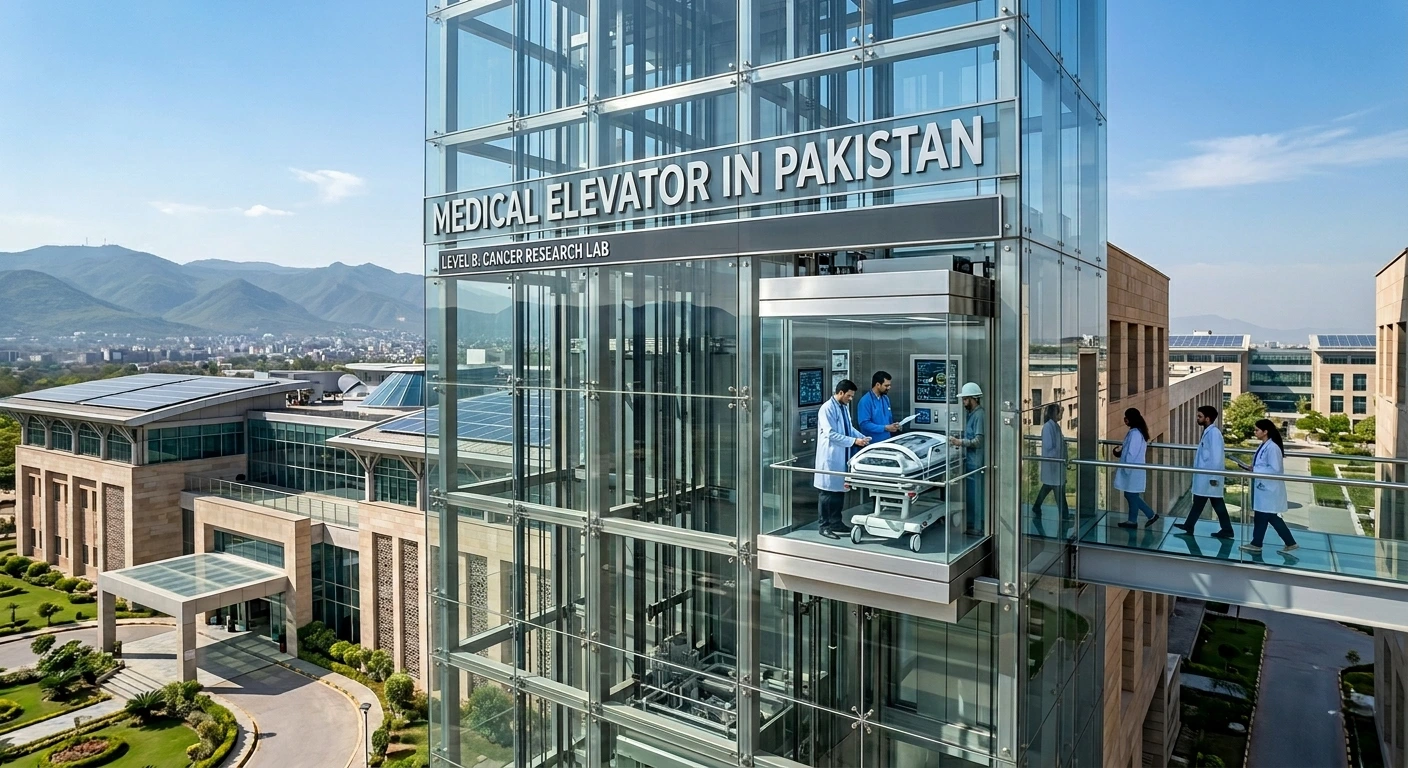
Medical Elevator in Pakistan: Standards, Cost & Installation
A patient being transferred from the ICU to the operating theatre cannot wait for an elevator that jolts, gaps at the landing, or stops abruptly between floors. A stretcher with an attached IV line and a nurse alongside it needs a cabin wide enough, a floor level enough, and a ride smooth enough that the transfer itself causes zero additional stress to a critically ill person.
This is why a medical elevator in Pakistan is not simply a larger passenger lift. It is an entirely different category of engineering, and installing the wrong type in a hospital or clinic is a decision with direct consequences for patient safety, regulatory compliance, and daily operational flow.
Milano Technologies supplies the KOYO Intelligent Stability Medical Elevator across Pakistan, a purpose-built hospital elevator system specifically engineered for the demands of modern healthcare facilities, with 3mm leveling precision, VVVF medical lift technology, and intelligent group dispatch built in as standard.
Why a Standard Passenger Elevator Fails in a Hospital Environment
Most hospital administrators who have replaced a standard elevator with a proper medical elevator describe the same experience: they did not fully understand what they were missing until they saw the difference in operation.
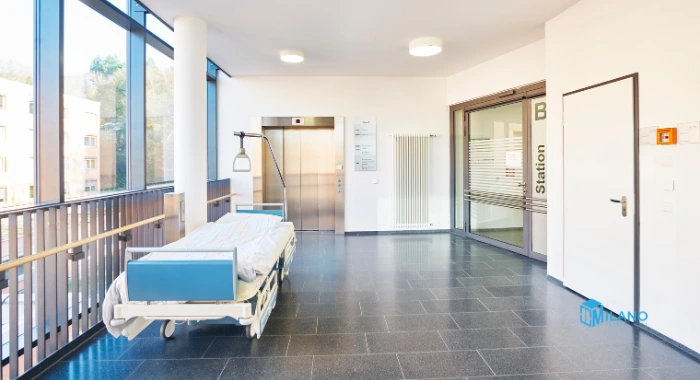
The failures of standard elevators in clinical settings are specific and predictable. Floor leveling gaps of 10 mm to 25 mm, which are acceptable in an office building, become a genuine hazard when a stretcher wheel catches at a landing during an emergency transfer. Abrupt acceleration and deceleration, standard in most commercial elevators, causes measurable discomfort to patients with spinal injuries, post-surgical cases, or compromised cardiovascular conditions. Cabin dimensions that fit eight adults comfortably cannot simultaneously fit a hospital bed, an attending nurse, and an attached monitoring unit.
Pakistan’s hospitals operating under Punjab Healthcare Commission (PHC), Sindh Healthcare Commission (SHC), and National Health Services Regulations and Coordination (NHSRC) standards are increasingly required to demonstrate that vertical transportation infrastructure meets healthcare-specific operational requirements. A medical elevator directly supports that compliance, whereas a repurposed commercial lift does not.
Medical Elevator Cost in Pakistan: Verified Price Breakdown by Configuration
Medical elevators are priced above standard commercial elevators due to their larger cabin dimensions, precision engineering requirements, specialised control systems, and 24/7 duty cycle design. The table below maps 2026 market pricing to hospital configuration.
Configuration | Capacity | Floors | Estimated Cost PKR | Best Facility Type |
Basic hospital elevator (MR) | 1,000 kg to 1,250 kg | 2 to 8 | 3,500,000 to 6,000,000 | Small clinics, diagnostic centres |
Standard medical elevator (MRL) | 1,250 kg to 1,600 kg | 3 to 12 | 5,000,000 to 8,500,000 | Mid-size hospitals, surgical centres |
Full hospital bed elevator (MR) | 1,600 kg to 2,000 kg | 4 to 20 | 7,000,000 to 12,000,000 | Large hospitals, teaching institutions |
High-speed medical elevator | 1,600 kg to 2,500 kg | 8 to 20+ | 10,000,000 and above | Multi-storey tertiary care hospitals |
Separate installation charges range from PKR 600,000 to PKR 1,800,000 depending on shaft specifications and civil scope. Monthly AMC for hospital elevators in Pakistan averages PKR 30,000 to PKR 70,000 due to the more frequent inspection requirements that healthcare environments demand.
One critical cost that hospitals frequently underestimate: emergency power backup. A medical elevator that stops mid-shaft during a power interruption with a patient on board is a serious incident. Dedicated UPS or generator integration for hospital elevator circuits adds PKR 200,000 to PKR 600,000 to the project cost but is non-negotiable in any facility licensed under PHC or SHC standards.
TBJ vs TBJW: The KOYO Medical Elevator Series Explained
The KOYO Intelligent Stability Medical Elevator is available in two configurations, each suited to a different hospital building profile.
- TBJ Series (Machine Room): is the right choice for large hospitals with high daily elevator cycles, such as tertiary care facilities, teaching hospitals, and multi-speciality centres operating 24 hours. The machine room configuration allows engineers to access the drive system directly without interrupting elevator service, which is important for facilities where even brief downtime has patient care implications. The TBJ series is optimised for maximum long-term reliability under continuous heavy-load use.
- TBJW Series (Machine-Room-Less): eliminates the dedicated machine room above the hoistway, making it the practical choice for mid-size hospitals, surgical day-care centres, and private clinics where floor plate efficiency matters. It operates at lower noise levels than the machine room variant, which is relevant for facilities where elevator cores adjoin patient recovery areas or consultation rooms. The TBJW series meets the same clinical performance specifications as the TBJ, including 3mm leveling accuracy and VVVF drive, while requiring less structural overhead.
Both series deliver what the product is named for: intelligent stability. The stable vector control system maintains high torque performance under uneven or heavy loads, ensuring smooth travel even when the cabin carries a fully loaded hospital bed, accompanying staff, and attached equipment simultaneously.
The 4 Technical Standards That Define a Genuine Medical Elevator
These four specifications separate a true medical elevator from a commercial lift sold into a hospital context. Verify each one before committing to any supplier.
- Leveling accuracy of 3mm or less. This is the single most important clinical safety specification. A floor gap larger than 3mm at any landing creates a trip and catch hazard for stretcher wheels and wheelchair castors. The KOYO TBJ and TBJW series achieve leveling within 3mm as a standard operating specification, not a best-case figure.
- VVVF drive control with optimised medical speed curves. Variable Voltage Variable Frequency drive generates smooth acceleration and deceleration curves specifically tuned for patient transport. The difference between a standard VVVF commercial elevator and a medical-grade VVVF system is in the speed curve programming. Medical elevators use slower, gentler ramp rates that reduce inertial forces on patients, particularly those with spinal conditions or post-anaesthesia sensitivity.
- Spacious cabin with wide door opening. Standard hospital bed dimensions in Pakistan require a minimum clear door opening of 1,100 mm and a cabin depth of at least 2,400 mm to allow a bed to enter and turn without wall contact. Confirm these specific dimensions in millimetres before ordering, not as a general “hospital-sized” description.
- Intelligent group dispatch with emergency priority mode. The Data Network Adaptive Control System in the KOYO medical elevator manages real-time dispatching across multiple elevator banks, reducing average wait time across all floors during peak hospital traffic. Critically, emergency priority mode overrides normal dispatching and directs the nearest available elevator to a designated emergency floor, which is an essential feature for facilities with active emergency departments.
Where Medical Elevators Are Required Across Pakistan’s Healthcare Sector
Understanding where demand is active helps procurement teams and hospital administrators benchmark their requirements against comparable facilities.
Facility Type | Elevator Requirement | Key Pakistani Cities |
Tertiary care hospitals (500+ beds) | Multiple high-capacity medical elevators, emergency priority dispatch | Lahore, Karachi, Islamabad |
District general hospitals | 2 to 4 medical elevators, bed and stretcher capacity | All provincial capitals |
Private surgical hospitals | 1 to 3 medical elevators, MRL preferred | DHA Lahore, Clifton Karachi, F-sectors Islamabad |
Diagnostic and imaging centres | 1 medical elevator, wide door for equipment transport | All major cities |
Rehabilitation and long-term care | Low-vibration medical elevator, accessibility features | Lahore, Rawalpindi, Karachi |
Medical teaching institutions | High-capacity, high-cycle medical elevators | Lahore, Karachi, Hyderabad |
Pakistan’s rapid expansion of private healthcare infrastructure, particularly in DHA and Bahria housing schemes across Punjab and Sindh, is generating active medical elevator demand in a segment that did not exist at this scale five years ago. Private surgical hospitals serving 50 to 150 beds, which are now common in these developments, require at least one fully specified medical elevator to meet both clinical need and licensing standards.
5 Questions Every Hospital Must Ask Before Approving a Medical Elevator Contract
These questions are specific to the healthcare context and go beyond what a standard elevator procurement checklist covers.
- What is the exact leveling accuracy specification in millimetres, and is it guaranteed in writing under the warranty terms?
- Are the VVVF speed curves set to medical-grade ramp rates, or are they standard commercial elevator profiles that have not been adjusted for patient transport?
- What is the cabin clear door opening width and internal depth in millimetres, and do these meet stretcher and hospital bed clearance requirements?
- Does the control system include emergency priority dispatch, and how is it activated during a clinical emergency?
- What is the response time for emergency breakdown service under the AMC, and does your team have technicians based within our city?
A supplier who cannot provide a written, specific answer to question one or two should not be shortlisted for a clinical installation.
The Vertical Transportation System Your Patients and Staff Depend On Every Day
In a hospital, the elevator is not background infrastructure. It is part of the care pathway. Every patient who moves between wards, every surgical case transferred to theatre, every piece of critical equipment relocated between departments travels through a medical elevator. Specifying that system correctly is as important as specifying any other clinical asset in the facility.
Milano Technologies supplies and installs the KOYO Intelligent Stability Medical Elevator in TBJ and TBJW configurations across Karachi, Lahore, and Islamabad, with complete project management from initial site assessment and shaft specification through to commissioning, clinical staff orientation, and ongoing AMC coverage. Whether your facility is a new tertiary care hospital in Lahore’s DHA, a private surgical centre in Karachi’s Clifton, or a diagnostic complex in Islamabad’s healthcare corridor, our team delivers the right medical elevator specification and the local engineering support to back it up.
Contact Milano Technologies on +92 347 711 1104 or visit our offices in Lahore, Islamabad, or Karachi for a free site assessment and proposal for your hospital elevator project.