Book Appointment Now

Electricity Requirement for Home Lift in Pakistan: What Every Homeowner Must Plan Before Buying
Most articles about home lift electricity talk about your monthly bill. In Pakistan, that is the wrong worry. The real question is not what a lift costs to run, it is whether it will run at all when the power goes, and whether your existing connection can even start it without tripping.
This is the practical electricity requirement for home lift in Pakistan guide that no global website gives you, because they have never planned a lift around load shedding, a single phase meter, or a WAPDA load sanction. If you are buying a home lift here, read this before you sign anything, because the electrical planning decides whether your lift is a convenience or a source of daily frustration.
The Good News First: A Home Lift Uses Less Power Than You Think
Homeowners imagine a lift as a heavy power drain like an air conditioner running all day. It is not. A modern home lift motor runs only while the cabin is moving, which is a few minutes across an entire day.
A typical compact home lift draws roughly 1.5 to 3 kW while moving and almost nothing at rest. Over a full day of normal family use, that adds up to about the same as running a couple of ceiling fans. The motor’s rated power looks large on paper, but because it works in short bursts, your actual units consumed stay low. So the electricity bill is not the problem. The connection and the backup are.
Single Phase or Three Phase? The Question That Decides Everything
This is the first real decision, and it affects both cost and convenience.
Most Pakistani homes run on a single phase connection. Many older or larger lift motors need three phase power, which means applying to your distribution company for a three phase connection and a higher sanctioned load, a process that takes time and adds cost. The smarter route for most homes is a single phase lift, a model whose motor and drive are designed to run on standard domestic supply. KOYO offers single phase compatible home lifts specifically so a family does not have to upgrade their whole connection just to install one. During our survey we check your meter type first, because this single fact reshapes the entire plan.
Understanding Your Lift Load Requirement Before You Apply
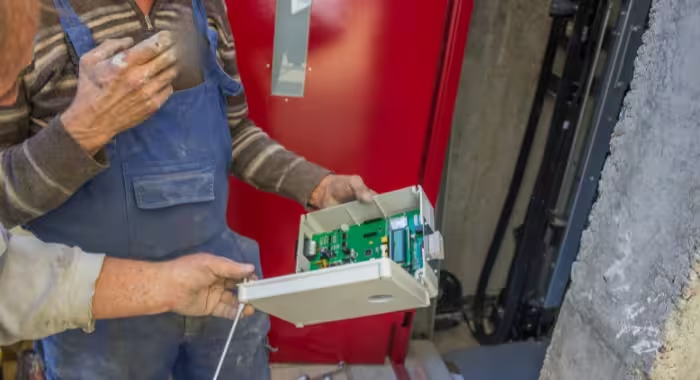
Every home in Pakistan has a sanctioned load, the maximum power your connection is approved for under your distribution company. Adding a lift raises your total demand, and if your sanctioned load is already tight, the lift can trip your main breaker on startup.
Here is the detail no competitor explains. A lift motor’s startup current is far higher than its running current, sometimes several times higher, for the split second it begins to move. A connection that looks adequate on average figures can still fail at that moment. Correct lift load requirement planning sizes everything against that startup surge, not the running average. This is why an experienced installer calculates your real demand rather than reading a number off a brochure.
The Load Shedding Solution: UPS and Generator Backup for Lift
This is the section every Pakistani buyer actually came for. A home lift must keep working, or at least keep you safe, when the power cuts mid ride.
Two things handle this. First, every KOYO lift includes an automatic rescue device, or ARD, a battery unit that detects a power failure, moves the cabin gently to the nearest floor, and opens the doors so no one is ever trapped. This is standard, not an upsell. Second, for full operation through longer outages, the lift runs on your home UPS or generator backup for lift use, sized correctly to its startup load. An undersized generator will rated on paper look fine yet stall when the lift motor kicks in, which is the most common backup mistake we are called to fix.
Home Lift Electrical Planning at a Glance
| Requirement | What Pakistani Homes Need | Why It Matters |
|---|---|---|
| Power draw | About 1.5 to 3 kW while moving | Low running cost, similar to a few fans |
| Connection type | Single phase compatible where possible | Avoids a costly three phase upgrade from your DISCO |
| Sanctioned load | Checked against startup, not average | Prevents the main breaker tripping when the lift starts |
| Power failure safety | Automatic rescue device, standard | Cabin reaches a floor and opens, nobody trapped |
| Full backup | UPS or generator sized to startup load | Keeps the lift usable through load shedding |
| Voltage stability | Stabilizer where supply fluctuates | Protects the control board from grid swings, per PSQCA safety norms |
Voltage Fluctuation: The Silent Killer of Lift Electronics
Load shedding gets all the attention, but unstable voltage quietly does more damage. Pakistani grid supply swings above and below the ideal 220 volts, and these surges degrade a lift’s control board over time. A voltage stabilizer matched to the lift protects the electronics and extends the life of the most expensive component in the system. In areas with known supply problems, we treat this as essential rather than optional, following equipment protection practice aligned with IEC electrical standards.
Plan Your Lift’s Power the Right Way With a Free Survey
Electrical planning is not a detail to sort out after installation, it is the decision that makes your lift reliable in Pakistani conditions. Milano Technologies installs KOYO home lifts across Lahore, Islamabad and Karachi, and every survey includes a full check of your connection type, sanctioned load, and backup needs before any quote is given.
Contact US: Call or WhatsApp +92 347 7111104 to book a free site survey, and we will make sure your home lift runs safely, load shedding or not.