Book Appointment Now

Lift Maintenance Checklist: The Complete Guide Every Building Manager
A lift does not fail suddenly. It warns you first, through a slightly rough stop, a door that hesitates, a faint noise on one floor. The buildings that get stuck with an out of order lift for weeks are almost always the ones that ignored those small signs. The buildings that never do are the ones following a proper lift maintenance checklist.
This guide gives you that checklist, organized the way maintenance actually happens: some checks daily, some monthly, some yearly. It also does something no other guide does. It separates the tasks you can safely check yourself from the ones that must be left to a qualified technician, because in Pakistan too many building managers either ignore maintenance entirely or let untrained staff open panels they should never touch.
Why a Checklist Beats Waiting for Something to Break
Reactive maintenance, meaning you only call someone when the lift stops, is the most expensive way to run a lift. A single failed component left unwatched damages the parts connected to it, turning a small service job into a major repair. A structured elevator maintenance checklist catches wear early, when a part can be adjusted or replaced cheaply, and keeps the lift available instead of trapping residents or losing a shop its customers. It also protects your warranty, since most manufacturers require documented servicing to honor a claim.
Daily and Weekly Checks Anyone Can Do
These require no tools and no panel opening, just attention. Building staff or the owner can perform them.
Ride the lift once and listen. New scraping, grinding or rattling means something has shifted. Watch the doors open and close on each floor, checking they move smoothly and reverse if you block them. Confirm the cabin stops level with the floor, since a lip between cabin and landing is both a trip hazard and an early sign of a leveling fault. Check that the cabin light, floor buttons and the emergency alarm all work. Finally, make sure the cabin and door tracks are free of dust and litter, which matters more in Pakistan than most guides admit.
The Monthly, Quarterly and Yearly Checklist
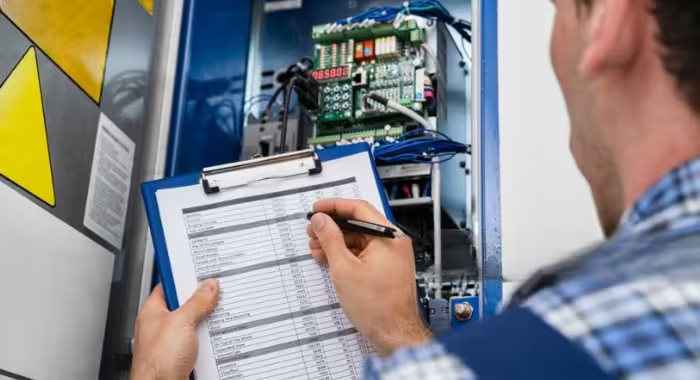
This is the core schedule. The deeper tasks below belong to a trained technician, and the table shows what happens at each interval.
| Interval | Checklist Tasks | Who Performs It |
|---|---|---|
| Monthly | Door operation and sensors, cabin leveling, alarm and intercom, lubrication of guide rails, visual check of the machine area | Technician, with owner observing |
| Quarterly | Wire rope and chain condition, brake function, controller and relay panel for burnt contacts, safety gear test, door lock circuits | Qualified technician only |
| Half yearly | Motor and drive inspection for vibration and heat, buffer check, counterweight guides, pit cleaning and drainage | Qualified technician only |
| Annually | Full load test, speed governor and overspeed check, emergency rescue device test, structural and shaft inspection, safety certification | Licensed engineer, per ASME A17.1 referenced practice |
Following an interval based plan like this aligns with international servicing principles set out by bodies such as OSHA for public equipment, adapted to local conditions.
The Pakistan Specific Checks Global Guides Miss
A checklist written for Europe or the US assumes stable power and clean, climate controlled buildings. Pakistani conditions add four items those guides never include.
Dust and lint clearance comes first. Airborne dust in Pakistani cities, and cotton lint in industrial towns, settles inside control panels and on moving parts, so cleaning intervals here must be tighter than the manual suggests. Backup system testing is second. The automatic rescue device that saves passengers during load shedding is only useful if its battery is healthy, so it must be tested, not assumed. Voltage protection is third, since grid swings damage control boards and any stabilizer must be checked for correct function. Heat management is fourth, because in cities like Multan and Karachi the machine space must stay ventilated so electronics do not overheat in summer.
Warning Signs That Mean Call a Technician Today
Some symptoms should never wait for the next scheduled visit. Stop using the lift and call your service provider immediately if you notice the cabin not leveling with floors, doors closing on passengers without reversing, unusual burning smells, sudden jolts or vibration during travel, or the emergency alarm and intercom failing. These are not cosmetic issues. They are the difference between a service call and an accident.
Why an AMC Is the Simplest Way to Stay Covered
Most building owners in Pakistan cannot personally track monthly and quarterly intervals, which is where an annual maintenance contract earns its value. A proper AMC schedules every visit in this checklist, keeps a documented service history that protects your warranty, provides genuine spare parts, and includes emergency breakdown response. Milano Technologies offers AMCs for KOYO lifts and also takes over servicing of lifts installed by other companies, which is one of the most common requests we receive from buildings whose original installer disappeared after handover.
Keep Your Lift Safe With a Professional Maintenance Plan
A checklist is only as good as the discipline behind it. Milano Technologies services KOYO lifts across Lahore, Islamabad, Karachi and beyond, following this full interval based checklist and documenting every visit.
Contact US: Call or WhatsApp +92 347 7111104 to arrange a maintenance audit or an annual contract, and keep your lift running safely through dust, heat and load shedding alike.