Book Appointment Now

New Lift vs Lift Modernization: What Every Pakistani Building Owner Gets Wrong
Every elevator eventually asks its owner a question it cannot answer on its own: replace me, or fix me. The lift keeps running, the doors keep opening, and the decision keeps getting postponed until a breakdown forces it. By then, the choice is rushed instead of researched.
The debate around new lift vs lift modernization is not really about which option looks better on paper. It is about matching the right intervention to the actual condition of your equipment, your building’s power situation, and how the lift is used day to day. Get that match wrong, and you either overspend on a full replacement you did not need, or you pour money into modernization that cannot fix a structural problem.
This guide breaks the decision down the way a technician would, not the way a sales brochure would.
What Counts as a New Lift Installation in Pakistan?
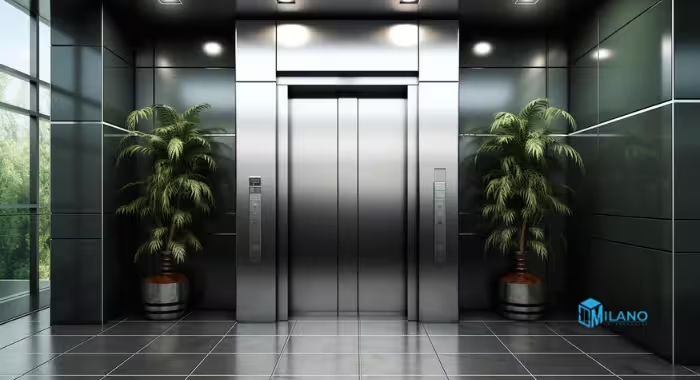
A new lift installation means removing the existing system entirely, including the machine, controller, car, guide rails, and often the shaft finishing, then building the elevator again from the ground up. It is the right call when the hoistway itself has outgrown the building’s needs, when the lift cannot meet current passenger or freight demand, or when the existing shaft dimensions restrict what technology can be installed.
For commercial plazas, hospitals, and multi-story residential towers going up across Lahore, Karachi, and Islamabad, a new installation is also the more practical route when the building is under construction anyway. Retrofitting a shaft after the structure is finished is always more complex than planning the lift alongside the architecture.
What Lift Modernization Actually Involves
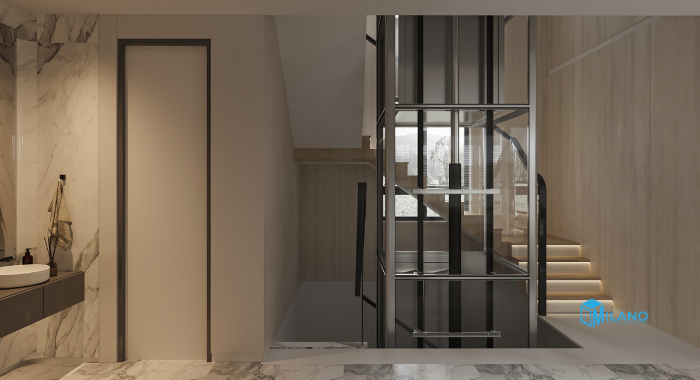
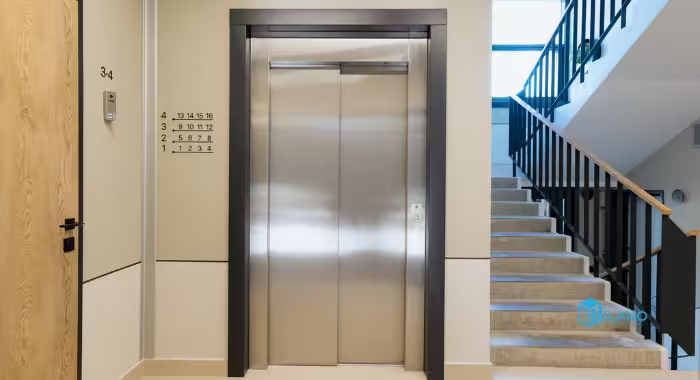
Modernization keeps the shaft, and often the car shell, while replacing the parts that fail most often and age fastest: the controller, motor, door operator, wiring, and safety devices. It is a targeted upgrade rather than a rebuild.
Most buildings do not need a new lift. They need the twenty-year-old relay-based controller replaced with a modern one, or a door operator that keeps jamming swapped for a smoother mechanism. Once those components are updated, the lift’s daily performance, ride comfort, and reliability improve without touching the structure around it.
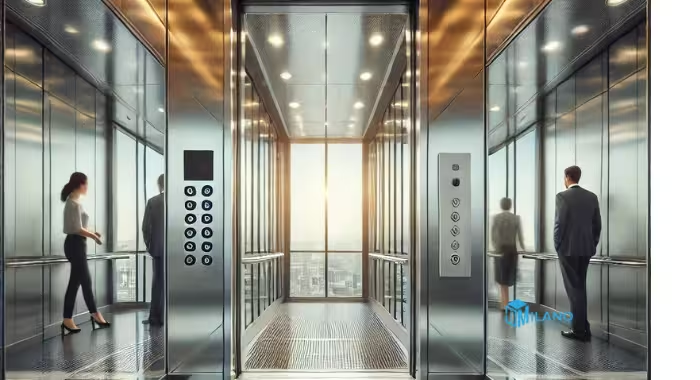
New Lift vs Lift Modernization: Side by Side
| Factor | New Lift Installation | Lift Modernization |
|---|---|---|
| Best suited for | Structural limitations, new construction, capacity changes | Mechanically sound shaft with outdated components |
| Typical downtime | Longer, full removal and rebuild | Shorter, phased component replacement |
| Long-term outlook | Full technology reset, longer service horizon | Extends service life when the core structure is sound |
| Disruption to building | Higher, especially in occupied buildings | Lower, can often be scheduled in stages |
| Where it fits Pakistan’s market | New commercial and residential towers under construction | Existing plazas, hospitals, and hotels with aging systems |
Lift Load Requirement: The Factor That Actually Decides Your Answer
Before anyone can responsibly recommend a new lift or a modernization, the lift load requirement of the building has to be established first. Load requirement is not just the weight rating on the nameplate. It covers passenger or freight capacity, car area, and how those numbers relate to actual daily usage, whether that’s a hospital moving patient beds or a residential tower moving furniture during move-in season.
International standards such as EN 81-20 define how rated load connects to minimum car area, and how that relationship changes as capacity increases. According to a detailed breakdown by Elevator World, passenger capacity calculations were revised decades ago to reflect a more realistic average passenger weight, and that figure still shapes how car area and rated load are matched today. If your building’s current lift was sized against outdated load assumptions or has simply outgrown its original purpose, that is a strong signal pointing toward new installation rather than modernization, because load capacity is tied to the physical car and shaft, not just the controller.
If the load requirement has not changed and the car comfortably handles daily traffic, modernization is usually enough. This single factor, more than age or appearance, is what separates the two paths.
Single Phase Lift or Three Phase: Why Your Power Supply Changes the Decision
Pakistan’s power infrastructure varies significantly between smaller residential buildings and larger commercial developments, and that difference matters more than most owners realize when comparing new lift vs lift modernization.
A single phase lift is typically suited to smaller buildings, home elevators, and low-rise structures with limited passenger loads, where the electrical connection available is single phase supply. Larger commercial plazas and high-traffic residential towers generally require three phase power to run heavier machines smoothly and avoid strain on the motor.
This distinction affects your decision directly. If an aging lift was originally designed around a single phase lift setup but the building’s usage has grown into commercial-scale traffic, modernization alone cannot solve that. The motor and machine room need to be reassessed against the correct power category, which often points toward new installation. On the other hand, if the phase supply already matches the building’s real demand and only the controller and wiring have aged, modernization keeps the same power setup while upgrading everything around it.
Generator Backup for Lift: The Question Pakistani Buildings Cannot Afford to Skip
Grid instability is a daily reality for building owners across Pakistan, which makes generator backup for lift one of the most overlooked factors in this entire decision. A lift stranded mid-shaft during a power cut is not just an inconvenience, it is a safety and liability concern, particularly in hospitals, hotels, and buildings with elderly or mobility-impaired residents.
Globally, building codes treat this seriously. As explained by Thompson Power Systems, major building codes require passenger elevators to draw power from both the normal supply and a standby source, covering the machine room, wiring, and hoistway lighting. Coverage in IAEI Magazine adds that standby systems are commonly required to transfer within about 60 seconds of a normal power failure. Pakistan does not yet have a single unified national code mandating this for every building class, which is exactly why so many local installations skip proper backup integration, leaving the responsibility entirely on the building owner or facilities manager to specify it.
When evaluating new lift vs lift modernization, this is where modernization has a clear practical advantage. Integrating generator backup for lift or automatic rescue functionality is often achievable as part of a controller upgrade, without touching the shaft or car. If your current lift strands passengers during load-shedding and has no automatic rescue device, that alone can justify a modernization project even if every other component is functioning normally.
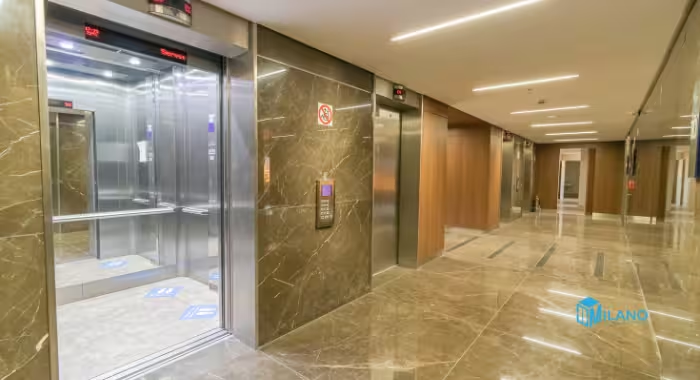
Where KOYO Fits Into This Decision
KOYO systems are engineered with modular controllers and machine components, which is precisely why modernization projects using KOYO technology tend to integrate cleanly into existing shafts without demanding structural changes. Whether a building needs a full new installation or a targeted controller and safety upgrade, the same engineering standard applies across both paths, so building owners are not choosing between quality and convenience.
For buildings weighing single phase lift versus three phase requirements, or planning generator backup for lift as part of an upgrade, KOYO’s component range is built to be assessed against the specific load and power profile of the site rather than forced into a one-size answer.
The Real Starting Point: An Assessment, Not a Purchase
Here is what most comparison articles skip entirely. Neither a new lift nor a modernization project should be the first step. A proper technical inspection covering the machine, controller, wiring, load history, and power supply should come first, because that inspection is what actually tells you which path applies to your building.
Many lifts that owners assume need full replacement are, on closer inspection, mechanically sound and simply overdue for a maintenance and component review. Conversely, some lifts that appear to run fine are quietly operating outside their safe load requirement or without any backup protection at all, both of which are maintenance and safety issues that show up long before a breakdown does.
If your lift is struggling with frequent stoppages, unclear load capacity, an outdated single phase lift setup that no longer matches your building’s traffic, or zero protection during power cuts, the next step is not choosing between new installation and modernization on your own. It is getting a qualified maintenance assessment first, so the decision is based on your building’s actual condition rather than a guess.
Milano Technologies works with building owners across Lahore, Karachi, and Islamabad to assess existing lift systems and recommend the right path forward using KOYO components engineered for Pakistan’s power and building conditions. Reach out to our team for a maintenance inspection before committing to either option.