Book Appointment Now


Home Lift Without Machine Room: Why Every Pakistani Home Should Consider It
Every Pakistani home builder faces the same rooftop dilemma. A traditional lift needs machinery in a dedicated machine room, almost always on the roof. That steals the exact space modern homes desperately need for water tanks and solar panels. A home lift without machine room, called an MRL or machine room less lift, solves this by hiding the machinery inside the lift shaft itself, leaving your entire rooftop free. But most people buy without understanding what that actually means, or what trade-offs come with it.
This guide explains how a machine room less lift really works, why it suits Pakistan specifically, and exactly what you are choosing when you pick one over a traditional system.
What Does a Home Lift Without Machine Room Actually Do?
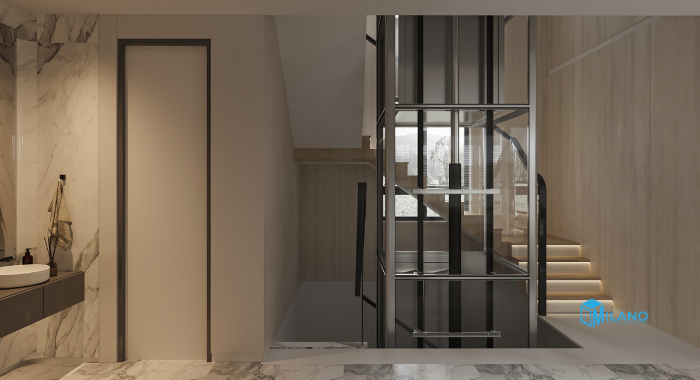
A traditional lift keeps its motor, drive system and controls in a separate machine room, a room about 3 meters by 2 meters that sits above the topmost floor. That room is dead weight for a home. An MRL system takes all those components and fits them inside the shaft, the vertical column of space the lift travels through.
The machinery operates the same way. An electric motor still turns, still lifts the cabin via cables and a counterweight system, still controls the speed and braking. The only change is location. Everything compacts into the shaft walls and the space at the top of the hoistway, using what would otherwise be wasted vertical space. The result for your home is simple: no machine room means no dedicated room lost, and the rooftop stays entirely usable.
Why This Matters for Pakistani Homes Specifically
In Lahore, Islamabad and Karachi, rooftop space is precious. Nearly every new home installs a water tank to survive intermittent supply. Many are now adding solar panels to hedge against electricity costs under rising NEPRA tariffs. An MRL frees that entire rooftop for both, which a traditional machine room lift cannot do.
The second reason is heat. Machinery in a separate machine room absorbs and radiates heat, a real problem in summer climates like Multan and Karachi. An MRL machine room mounted high in the shaft puts electronics out of the direct heat and improves cooling, which matters as summer temperatures climb past 45 degrees.
How MRL Lifts Handle the Load Shedding Problem
Pakistan’s power cuts affect all lifts the same way, but an MRL handles the solution more elegantly. Every modern lift includes an automatic rescue device that moves the cabin to the nearest floor and opens the doors during a power failure, so no one is trapped. For full operation through load shedding, you still need a backup, either a UPS or a generator sized to the lift’s startup current.
An MRL’s compact design makes the backup easier to calculate and size correctly. The machinery concentrated in the shaft has a clear power profile, simpler than tracking a distributed machine room system. This precision matters in Pakistan where undersized generators are a common mistake that kills the lift on startup.
MRL Home Lifts vs Traditional Lifts at a Glance
| Aspect | Home Lift Without Machine Room (MRL) | Traditional Lift |
|---|---|---|
| Machinery location | Inside the shaft, no separate room | Dedicated room above top floor |
| Rooftop use | Entirely free for water tank, solar, terrace | Machine room takes 6+ sq meters |
| Installation complexity | More advanced technology, longer commissioning | Simpler mechanical work, faster install |
| Energy use | 20 to 40% lower than hydraulic lifts | Hydraulic units use more power |
| Maintenance access | From inside the shaft, compact work area | Spacious room, easier technician access |
| Suitable for retrofits | Yes, if shaft space exists | No, requires major structural work |
| Heat generation | Lower, machinery cooled in shaft | Higher, concentrated in room |
| Pakistan conditions | Better for dust management, compact layouts | Traditional choice in older buildings |
The Real Trade-Off: Advanced Technology Needs Skilled Service
An MRL is more technologically complex than a traditional lift. The motor and drive system fit into a tighter space, the control electronics are more advanced to optimize that space, and alignment tolerances are tighter. This means two things. First, commissioning takes longer, roughly a week versus a few days for a traditional lift. Second, maintenance must be done by a technician who understands the specific MRL model, not just any general lift mechanic.
In Pakistan, where after sales service has been historically weak, this matters. You must choose an installer whose technical team stays with you long term, not one who disappears after handover. Milano Technologies supports every KOYO MRL it installs in Pakistan with dedicated technicians trained on that specific system, because an orphaned MRL gets worse, not better.
Choose an MRL If You Want Your Rooftop Back
A home lift without machine room is not just a convenience. In Pakistan, where rooftops now carry tanks and panels, it is the smart choice for any home tall enough to need a lift. Milano Technologies installs KOYO MRL lifts across Lahore, Islamabad and Karachi, with the technical team staying to support your system for its entire life.
Call or WhatsApp +92 347 7111104 to book a free survey and see if an MRL is right for your home.