Book Appointment Now

Goods Lift for Factory in Pakistan: Complete Buyer Guide for Industrial Use
Every factory owner in Pakistan has watched the same scene play out on a loading floor. Workers carrying heavy rolls of fabric up a ramp, pallets being manually shifted between production levels, finished goods stacked precariously on a makeshift platform because the building has two floors and no proper vertical transport. The back injuries, the damaged stock, the time lost on every shift, and the production bottlenecks that follow are all entirely preventable.
A goods lift for a factory is not a luxury addition. In a two-storey or three-storey industrial facility, it is the piece of infrastructure that determines whether your production floor runs efficiently or fights its own layout every single day. And in Pakistan’s two largest manufacturing cities, Faisalabad’s textile sector and Sialkot’s surgical and sporting goods industry, the demand for properly specified industrial lifts has grown sharply as factory owners move from makeshift solutions to proper vertical transport.
This guide covers everything a Pakistani factory owner, plant manager or industrial developer needs to know before specifying a goods lift, from load capacity and platform dimensions to safety requirements and the specific conditions Pakistani industrial environments create.
Why Pakistani Factories Have Unique Goods Lift Requirements
A goods lift specification written for a European warehouse does not translate directly to a Pakistani factory, and the differences matter more than most suppliers explain.
Pakistan’s industrial buildings, particularly in Faisalabad’s textile clusters and Sialkot’s export manufacturing zones, were often built before vertical transport was part of the design brief. Many are multi-storey structures with tight floor-to-floor heights, narrow loading areas and power supply conditions that a standard specification does not account for.
According to the Pakistan Bureau of Statistics, manufacturing contributes over 13 percent of Pakistan’s GDP, with textile and garment manufacturing alone employing millions of workers across Punjab. The density of multi-storey factory buildings in cities like Faisalabad, Sialkot, Lahore and Karachi creates a specific demand for goods lifts that handle industrial loads in constrained spaces, on WAPDA three-phase supply with its characteristic voltage fluctuations, and through working days that can run eighteen hours during peak export seasons.
These conditions demand a specification that goes beyond a standard commercial freight elevator.
Load Capacity: The Number That Decides Everything Else
Load capacity is the first and most consequential specification in any goods lift for factory use, and it is the one most often underestimated during the buying process.
Factory owners frequently calculate their heaviest single load and specify to that number. The correct approach is different. You should specify to your heaviest anticipated load plus a safety margin of at least 25 percent, because rated capacity is a maximum that should never be approached in daily operation. Running a goods lift consistently at or near its rated load wears the drive, the ropes and the structural components at an accelerated rate and significantly shortens the service life of the equipment.
For Faisalabad textile factories, the relevant loads are fabric rolls, which can weigh 200 to 400 kg each depending on the material, yarn cones on trolleys, finished garment batches on hanging rails, and the trolleys or carts themselves. For Sialkot factories producing surgical instruments or sporting goods, loads are typically lighter per item but are moved on metal shelving units and packing trolleys that add dead weight to every lift.
The Occupational Safety and Health Administration publishes guidance on industrial material handling that is widely referenced by engineering consultants in Pakistan, and its framework consistently identifies overloading as the primary cause of goods lift failure and workplace injury in industrial settings.
Platform Dimensions: Why Size Matters More Than Capacity in Factory Applications
A goods lift can have the right load rating and still be useless if its platform cannot accept the items your factory actually moves. This is the specification gap that causes the most post-installation regret.
Standard freight elevators are designed for pallets and boxes. Factory goods lifts in Pakistan must accommodate the specific material handling equipment each industry uses, and that equipment rarely matches standard platform dimensions.
In a textile factory, the critical dimension is often width. Wide fabric rolls transported on floor-level trolleys need a platform that accepts the trolley without tilting the load. In a packing facility, the height of the goods lift opening determines whether standard packing frames can enter without being disassembled. In a cold storage or food processing facility, the platform needs drainage and a surface material that tolerates cleaning chemicals.
The correct approach is to measure your three largest items that will regularly use the lift, including the trolley or handling equipment they travel on, and specify the platform to those dimensions with a minimum 200mm clearance on each side. This is a step that a proper site survey confirms with a tape measure in your actual facility rather than a figure estimated from a catalogue.
Goods Lift Specifications for Pakistani Factory Types
| Factory Type | Recommended Capacity | Platform Size | Door Type | Key Requirement |
|---|---|---|---|---|
| Textile (Faisalabad) | 2,000 to 5,000 kg | 2.0m x 2.5m minimum | Bi-parting industrial | Wide opening for fabric rolls and hanging rails |
| Surgical and sports goods (Sialkot) | 1,000 to 2,000 kg | 1.5m x 2.0m | Single or bi-parting | Precision leveling for delicate instruments |
| Garment finishing and packing | 1,500 to 3,000 kg | 1.8m x 2.2m | Bi-parting | Height clearance for hanging garment frames |
| Food processing and cold storage | 2,000 to 4,000 kg | 2.0m x 2.5m | Stainless interior | Chemical-resistant flooring and drainage |
| General manufacturing and warehousing | 2,000 to 5,000 kg | 2.0m x 2.5m | Bi-parting industrial | Forklift entry capability if ground floor loading |
| Pharmaceutical and medical | 1,000 to 2,000 kg | 1.5m x 2.0m | Automatic sliding | Clean room compatible surfaces |
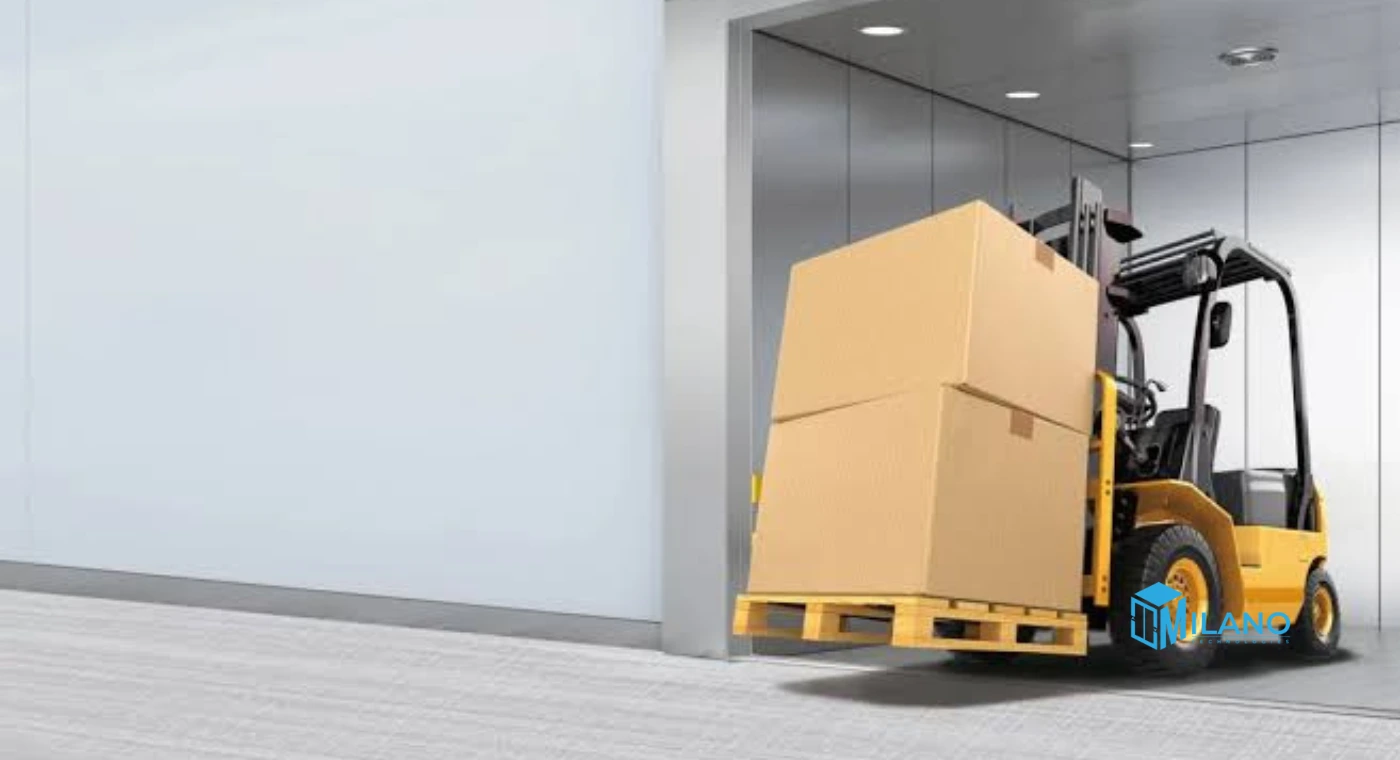
The door specification in a goods lift for factory use deserves separate attention. Bi-parting doors, which open from the centre outward in both directions, provide the widest clear opening relative to the platform size and are the correct choice for industrial applications where loads are moved by forklift or wide trolley. Manual swing doors are inappropriate for factory goods lifts because they require a clear swing zone that industrial loading areas rarely provide.
Drive System for Factory Conditions in Pakistan
The choice of drive system for a goods lift in a Pakistani factory is influenced by three factors that would not appear in a standard specification: three-phase power quality, duty cycle intensity and maintenance access.
Hydraulic drive suits factory goods lifts in specific configurations. For ground floor to first floor applications with very heavy loads, hydraulic drive generates the lifting force required with mechanical simplicity. Its weakness in Pakistani factories is oil maintenance under high duty cycles and the heat it generates during peak production shifts, when the lift may run continuously for hours. Regular oil quality checks are not optional in this environment.
Traction drive with variable frequency control is the preferred system for factory goods lifts of two or more stops, because the variable frequency drive smooths the motor’s startup and stop cycle, reduces the startup current surge that can trip breakers on a loaded WAPDA three-phase connection, and handles the high duty cycles of continuous production shifts without overheating. The Institute of Electrical and Electronics Engineers documents variable frequency drive benefits for industrial motor applications extensively, and the startup current reduction is particularly relevant in Pakistani factories where connection capacity is often tight.
For factories in industrial estates in Faisalabad and Sialkot where FESCO and SESCO supply conditions mean voltage fluctuations are a daily reality, a voltage stabilizer matched to the lift’s control panel is essential, not optional. Control board damage from grid instability is the most common cause of goods lift downtime in Pakistani industrial facilities.
Safety Requirements That Pakistani Factory Owners Cannot Overlook
A goods lift operating in a factory carries a liability that a passenger elevator in an office building does not. Workers are in close proximity to moving loads, loading areas are often congested, and the consequences of a safety failure are more severe than in a commercial setting.
The following safety features are non-negotiable in a properly specified factory goods lift, and their presence should be confirmed in writing before any installation is accepted.
Overload protection must cut power to the drive before the rated capacity is exceeded, not simply sound an alarm. Landing door interlocks must prevent platform movement unless every floor door is fully closed and mechanically locked. A slack rope detector must stop the platform immediately if rope tension drops, which can indicate a rope failure or obstruction. A leveling accuracy system must bring the platform within 10mm of floor level to prevent trolley wheels catching on the landing edge, which is a primary cause of load tipping and worker injury. Emergency stop buttons must be positioned at every landing and inside the platform, accessible without reaching past a moving load.
According to the International Labour Organization’s guidelines on occupational safety in manufacturing, inadequate guarding and missing safety interlocks on industrial lifting equipment account for a disproportionate share of manufacturing sector injuries globally. In Pakistan’s industrial cities, where factory inspection regimes are developing, the building owner bears direct responsibility for specifying equipment that meets these requirements from installation day.
Installation Considerations for Existing Factory Buildings
Most goods lift installations in Pakistan’s established industrial areas are retrofits into buildings that were designed without a lift shaft. This creates specific civil work challenges that differ from a new build.
Floor slab penetration for a retrospective shaft requires structural assessment of the slab thickness and reinforcement before cutting. In Faisalabad’s older textile mills, which often have thick reinforced concrete floors designed for heavy loom machinery, this assessment is essential before any cutting work begins. The pit excavation below the ground floor must be waterproofed correctly, as many industrial areas have high water tables that can flood an unprotected lift pit. Headroom at the top floor must accommodate both the platform travel and the drive machinery for a conventional traction system, or the shaft top equipment for an MRL installation.
A proper site survey by a qualified engineer resolves all three questions before any commitment is made, and any supplier quoting without a survey of the existing structure is not giving you a reliable figure.
Specify Your Factory Goods Lift the Right Way With a Free Survey
A goods lift for factory use is a production asset, not a building feature, and it should be specified with the same rigour as any other piece of industrial equipment. Milano Technologies supplies and installs KOYO industrial goods lifts and freight elevators across Faisalabad, Sialkot, Lahore and Karachi, with every installation preceded by a proper site survey and a written specification confirming capacity, platform dimensions, drive type and safety features.
Contact Us: Call or WhatsApp +92 347 7111104 to book your free site survey, and we will specify the right goods lift for your factory’s actual loads, your building’s actual constraints and your production floor’s actual demands.
[…] lift in a 10 marla house in Lahore, a passenger elevator in a commercial plaza in Karachi, or a goods lift in a factory in Faisalabad, the timeline structure is the same even if the specific numbers […]