Book Appointment Now

How Long Does Lift Installation Take in Pakistan? Full Timeline Explained
The question every building owner asks after agreeing to buy a lift is the one that affects everything else: when will it actually be ready?
The answer they usually get is a vague range delivered with a shrug. Four to eight weeks. Depends on the building. We will let you know. That answer causes planning failures, construction delays, missed move-in dates and contractor disputes across Pakistan every single week.
This article gives you the honest, phase by phase timeline for lift installation in Pakistan, including what takes longer than buyers expect, what causes delays that are entirely avoidable, and what your building must have ready before the installer arrives. Whether you are installing a home lift in a 10 marla house in Lahore, a passenger elevator in a commercial plaza in Karachi, or a goods lift in a factory in Faisalabad, the timeline structure is the same even if the specific numbers differ.
Why “It Depends” Is Not Good Enough: The Real Variables Behind Lift Installation Time
Lift installation time in Pakistan genuinely varies, but not randomly. It varies because of five specific factors that can be identified, quantified and planned for at the survey stage, which is why the survey is not a preliminary formality but the document that makes the entire timeline reliable.
The five variables are building type and number of floors, shaft readiness at the time of installation, equipment import and customs clearance, site access and working conditions, and testing and commissioning requirements. Each of these is discussed in its own section below, because each one can independently add days or weeks to a project if not planned for correctly.
According to the National Association of Elevator Contractors, improper pre-installation planning is the single most cited cause of elevator installation delays in commercial and residential projects globally. In Pakistan, where import lead times, customs clearance and site readiness add layers that domestic markets do not face, this planning gap is even more consequential.
Phase 1: Site Survey to Confirmed Order | 3 to 7 Working Days
The timeline does not begin when the equipment arrives. It begins at the site survey, and the quality of that survey determines whether every subsequent phase runs on schedule or accumulates delays.
A proper site survey measures shaft dimensions, pit depth and headroom clearance, confirms the power supply type and sanctioned load, identifies civil work that must be completed before installation can begin, and records any site-specific constraints like narrow access corridors, active building occupation or restricted working hours. This is not a sales visit. It is an engineering document.
After the survey, the installer confirms the specification, the building owner approves the proposal, and the order is placed. In Pakistan, this phase typically takes three to seven working days from survey to confirmed order when the building owner is prepared with decision authority and the survey findings are straightforward. Delays in this phase almost always come from one source: the building owner discovering civil work requirements they did not know existed and needing time to arrange them.
Phase 2: Equipment Order, Import and Customs Clearance | 4 to 10 Weeks
This is the phase that surprises Pakistani buyers most, because elevator equipment in Pakistan is predominantly imported, and import timelines operate on a different clock from local procurement.
KOYO elevator systems are manufactured and shipped from internationally certified production facilities. The equipment order, production scheduling, shipping and customs clearance through Pakistani ports typically takes four to eight weeks under normal conditions. When customs clearance is smooth and documentation is complete, the lower end of that range is achievable. When documentation issues arise, port congestion delays clearance, or a specific component needs to be sourced separately, the timeline extends.
The Pakistan Customs clearance process for mechanical and electrical equipment requires correct classification, complete import documentation and in some cases physical inspection. A professional elevator company handles this entire process on behalf of the building owner, but the timeline cannot be compressed beyond the port and customs system’s own pace.
For building owners with a fixed move-in date or construction completion deadline, this phase is the one to plan around first, because it is the least flexible in the entire timeline.
Phase 3: Civil Work Preparation | Parallel to Import, 1 to 4 Weeks
This phase runs parallel to the import phase, which means a well-managed installation uses the equipment transit time productively rather than waiting for the lift to arrive before starting civil preparation.
Civil work for a lift installation includes pit excavation and waterproofing at the base of the shaft, shaft wall construction or reinforcement if the shaft is being built during installation rather than reserved during construction, headroom preparation at the top of the shaft, and electrical supply installation including the dedicated circuit from the main distribution board to the machine space.
In a new building where the shaft was reserved correctly during construction, civil work is minimal and can be completed in one to two weeks. In a retrofit installation into an existing building, civil work is more substantial and requires coordination with a civil contractor before the elevator installation team arrives.
The single most common cause of installation delays in Pakistan is equipment arriving at site while civil work is still incomplete. An elevator installation team cannot begin mechanical work in an unfinished shaft, and waiting for civil completion after equipment delivery adds direct cost and dead time to the project.
Phase 4: Mechanical Installation | 7 to 21 Working Days
This is the phase most people think of as “the installation,” and it is where the timeline varies most by building type and elevator specification.
| Building and Lift Type | Typical Mechanical Installation Time | Key Variables |
|---|---|---|
| Home lift, 2 to 3 stops | 7 to 10 working days | Shaft readiness, access to all floors |
| Residential elevator, 4 to 6 stops | 10 to 14 working days | Building occupation during installation |
| Commercial passenger elevator | 14 to 21 working days | Floor count, cabin specification complexity |
| Goods lift for factory | 10 to 18 working days | Platform size, heavy component handling |
| Escalator (commercial) | 14 to 21 working days | Truss size, floor structure |
| Hospital elevator | 14 to 21 working days | Infection control requirements, phased access |
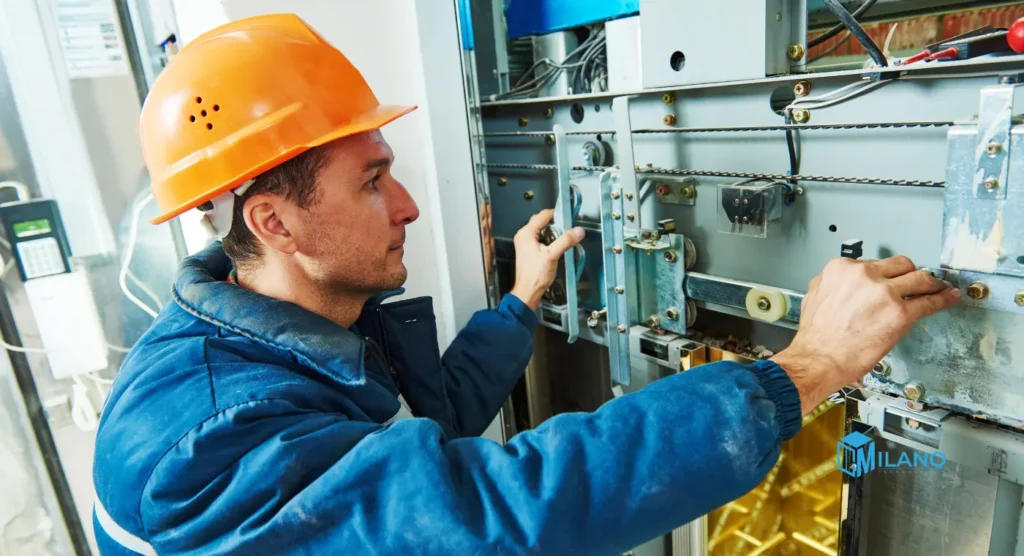
Mechanical installation involves guide rail fixing to the shaft walls, drive machinery installation, rope or hydraulic system assembly, cabin and door installation on each floor, electrical wiring from machine space to all landings, and control system configuration. Each of these is a sequential task that cannot be rushed without compromising accuracy, and accuracy in an elevator installation is a safety requirement, not a quality preference.
According to the American Society of Mechanical Engineers ASME A17.1 code, guide rail alignment tolerances, rope tension specifications and door interlock adjustment all have defined parameters that must be achieved before the system can be commissioned. These are not targets to aim for. They are minimum requirements that a competent installation team builds to from the start.
Phase 5: Testing, Commissioning and Handover | 2 to 5 Working Days
Testing and commissioning is the phase that separates a completed installation from a safe, ready-to-use elevator, and it is the phase most often compressed or skipped entirely by installers under schedule pressure.
A proper commissioning procedure for a lift installed in Pakistan includes a full rated load test, where the cabin carries its maximum permitted weight across the full travel of the shaft to verify the motor, brake and safety gear under real operating conditions. It includes an overspeed governor test, confirming that the safety gear engages correctly when triggered. It includes door interlock testing at every landing, confirming that the cabin cannot move unless every door is fully closed and locked. It includes the Automatic Rescue Device test, simulating a power failure to confirm the battery moves the cabin to the nearest floor and opens the doors correctly.
The Elevator Escalator Safety Foundation identifies the load test and safety gear test as the two most critical pre-handover verifications, and their research shows that elevators commissioned without these tests have a significantly higher rate of early safety failures. In Pakistan, where no mandatory third-party inspection regime currently exists for most building types, the building owner’s only protection is insisting on a witnessed commissioning procedure and receiving a signed commissioning report before the installer leaves the site.
The Complete Lift Installation Timeline at a Glance
| Phase | Duration | Who Is Responsible | What Can Cause Delays |
|---|---|---|---|
| Site survey to confirmed order | 3 to 7 working days | Installer surveys, owner decides | Civil work surprises, delayed decisions |
| Equipment import and customs | 4 to 10 weeks | Installer manages | Documentation gaps, port congestion |
| Civil work preparation | 1 to 4 weeks (parallel) | Owner’s civil contractor | Slow contractor, incomplete drawings |
| Mechanical installation | 7 to 21 working days | Installer’s technical team | Incomplete shaft, restricted access |
| Testing and commissioning | 2 to 5 working days | Installer’s engineer | Failed tests requiring adjustment |
| Total realistic timeline | 8 to 16 weeks | Joint responsibility | Planning gaps at any phase |
What Pakistani Building Owners Must Have Ready Before Installation Begins
This section is the one that saves the most time in practice, because the delays that hurt construction schedules in Pakistan almost never come from the elevator company. They come from site conditions that were not ready when the installation team arrived.
The shaft must be fully constructed, plastered and dry before guide rail fixing begins. Wet plaster or incomplete masonry forces the installation team off site and the restart adds days. The dedicated electrical supply to the machine space must be installed and live, because the installation team cannot test or commission without power. All floors must be accessible during working hours, which in an occupied residential building requires coordination with existing residents that must be arranged before installation begins, not discovered when the team arrives. The pit must be waterproofed and dry, because any water in the pit forces a stop while the building contractor resolves it.
Why the Survey Is the Only Way to Get an Accurate Timeline for Your Building
Every number in this article is a range because every building is different. The site survey is the event that turns those ranges into a specific timeline for your project. A survey conducted by an experienced engineer at your actual site, looking at your actual shaft, measuring your actual pit and confirming your actual electrical supply, produces a timeline that is accurate rather than estimated.
Building owners who skip the survey and ask for a timeline over the phone are planning with a number that has no foundation in their actual project conditions. When that number proves wrong, the delay falls on the construction programme, the contractor relationships and ultimately the budget.
Book Your Free Survey and Get a Real Timeline for Your Building
The only accurate answer to how long lift installation takes in Pakistan is the one produced by a site survey of your specific building. Milano Technologies surveys sites across Lahore, Islamabad and Karachi at no charge, and provides a written proposal with a phase by phase installation timeline within three working days of the survey.
Contact Us: Call or WhatsApp +92 347 7111104 to book your free site survey, and we will give you a timeline you can actually plan around, not a range you have to guess from.