Book Appointment Now

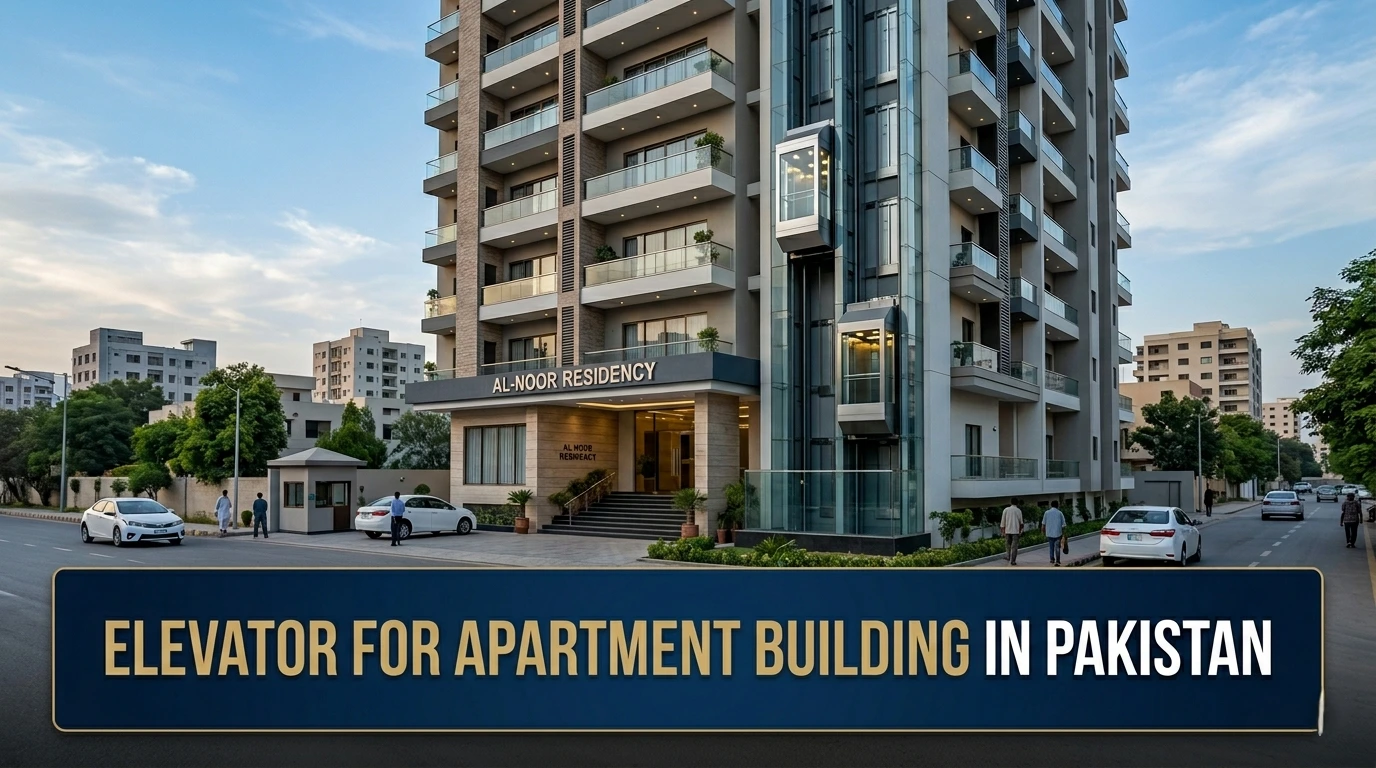
Elevator for Apartment Building in Pakistan: Buyer’s Guide to Capacity, Types & Pricing
- On
- InBlog
Pakistan’s urban housing landscape has changed permanently. In Lahore, Karachi, and Islamabad, apartment buildings below 5 storeys were once considered “walkable.” That thinking is outdated.
Today, buyers actively compare buildings based on lift availability before they compare price per square foot. Developers who skip elevator planning during construction end up retrofitting later — at significantly higher cost, with major structural disruption.
If you’re building, buying into, or managing an apartment building in Pakistan, this guide covers exactly what you need to know: which elevator type suits your building, what load capacity you actually need, and what realistic 2025 prices look like.
How Many Floors Before You Need an Elevator?
There’s no single national building code in Pakistan that mandates elevator installation at a specific floor count — but the internationally followed rule of thumb used by architects and consultants is:
- 4 storeys and below — elevator is optional but increasingly expected
- 5 storeys and above — elevator is considered essential; most lenders and buyers require it
- 8+ storeys — a single elevator is insufficient; two lifts are the minimum for resident comfort
Beyond code considerations, practical traffic matters. Industry guidance suggests one elevator per 90–100 residential units for standard apartments, and one per 50–60 units for premium buildings where wait time is a selling point.
For a typical 6-storey, 24-unit apartment block in Lahore or Karachi, one well-specified passenger elevator is adequate. For anything above 10 floors, two lifts in separate shafts provide redundancy and reduce waiting time during peak hours.
Choosing the Right Elevator Type for Your Apartment Building
Not every lift system suits every building type. Here’s a practical comparison:
Elevator Type | Best For | Speed | Key Advantage | Limitation |
Traction (MRL) | 5–20 storey apartments | 1.0–1.75 m/s | No machine room, space-saving | Higher upfront cost |
Hydraulic | 2–6 storey buildings | 0.4–0.6 m/s | Smooth, quiet ride | Requires machine room |
Gearless Traction | High-rise 10+ floors | 1.75–2.5 m/s | Fast, energy-efficient | Most expensive |
MRL Passenger Lift | Mid-rise 5–10 floors | 1.0–1.5 m/s | Compact shaft design | Slightly higher maintenance |
For most apartment buildings in Pakistan — typically 5 to 12 storeys — a Machine Room-Less (MRL) traction elevator is the practical standard. It combines a compact footprint with the speed and reliability that residential use demands.
Capacity: What Load Rating Does Your Building Actually Need?
Capacity is measured in kilograms or number of passengers. Getting this wrong is one of the most common mistakes in residential elevator planning.
General capacity guide for apartment buildings:
Building Size | Recommended Capacity | Why |
Up to 6 floors, ≤24 units | 630 kg (8 passengers) | Adequate for standard residential traffic |
6–12 floors, 25–60 units | 800–1000 kg (10–13 passengers) | Handles peak load; furniture movement |
12+ floors or 60+ units | 1000–1250 kg (13–16 passengers) | Required for comfort + redundancy planning |
One detail that gets overlooked: at least one elevator in multi-storey residential buildings should have a minimum ceiling height of 2.2 metres to allow furniture, large appliances, and wheelchair users to move comfortably. This is not a luxury — it’s a practical necessity.
Speed matters too. Residential lifts in Pakistan typically run at 0.5 to 1.0 m/s. For buildings above 10 floors, 1.5 m/s reduces average wait time significantly and improves resident satisfaction.
2025 Cost Breakdown: Elevator for Apartment Building in Pakistan
Elevator pricing in Pakistan varies based on type, capacity, number of stops, and whether the installation is new construction or a retrofit.
Elevator Type | Capacity | Estimated Price (PKR) | Stops |
Basic Passenger Lift | 630 kg | 1.8M – 2.5M | Up to 6 |
MRL Passenger Elevator | 800 kg | 2.8M – 4.0M | Up to 10 |
MRL High-Capacity | 1000 kg | 4.0M – 5.5M | Up to 15 |
Gearless Traction | 1250 kg | 5.5M – 8.5M | 15+ |
Retrofit/Existing Building | 630–800 kg | Add 15–25% premium | Varies |
Prices are indicative for 2025. Final cost depends on shaft dimensions, finishes, brand, and local installation complexity.
What drives cost up:
- Retrofitting into an existing structure (requires shaft cutting, structural reinforcement)
- Customised cabin finishes (stainless steel is standard; wood, glass, or mirror panels add cost)
- Higher speed motors
- Additional safety features like ARD (Automatic Rescue Device) and UPS backup
What keeps cost reasonable:
- Planning the shaft during initial construction — this is the single biggest cost-saving decision
- Choosing MRL over conventional machine-room designs
- Standard cabin finishes
- Selecting a locally serviced brand to reduce long-term maintenance costs
Annual Maintenance: The Cost Builders Forget to Budget For
The purchase price is not the full picture. Elevators require regular servicing to remain safe and legally operable.
In Pakistan, annual maintenance contracts (AMC) for residential elevators typically range from PKR 80,000 to PKR 200,000 per year, depending on the brand, elevator type, and number of visits included. This covers lubrication, brake inspection, door mechanism checks, and electrical testing.
Skipping maintenance doesn’t just risk breakdowns — it shortens the operational lifespan of the system significantly. A well-maintained lift runs reliably for 20–25 years. A neglected one can develop major faults within 5–7 years.
When comparing elevator vendors, always ask: Do you have a local service team in my city? Remote-supported brands with no local engineers mean long downtime when something goes wrong.
Key Questions to Ask Before Buying an Elevator for Your Apartment Building
Before signing any contract, these are the questions that protect your investment:
- Is the shaft designed during construction or retrofitted? New construction shafts are always more cost-effective. Retrofit projects involve structural work that can add 20–30% to total cost.
- What certifications does the elevator carry? Look for ISO-certified products and CE-marked components. These are internationally recognised quality benchmarks.
- Does the supplier offer an AMC? A supplier who doesn’t offer post-installation maintenance should be a red flag.
- What is the lead time for spare parts? Elevators with locally stocked spare parts recover faster from faults. Ask specifically about door motors, control boards, and brake components.
- What is the warranty period? Standard industry warranty in Pakistan is 12 months on parts and workmanship. Premium suppliers offer 24 months.
Choosing the Right Elevator Partner in Pakistan
Given the long-term nature of elevator ownership — you’re committing to a 20+ year relationship with your supplier — local expertise matters as much as product quality.
Milano Technologies installs and services elevators across Pakistan, including passenger lifts for apartment buildings, residential home elevators, and commercial solutions. Our team provides site assessments, shaft specifications, and post-installation maintenance to keep your building running reliably.
Quick Reference Summary
Factor | Recommendation |
Floors 4 and below | Optional but adds property value |
Floors 5–12 | MRL traction elevator, 800–1000 kg |
Floors 12+ | Gearless traction, 1000–1250 kg, consider 2 lifts |
Units per elevator | 1 per 90–100 units (standard); 1 per 50–60 (premium) |
Budget range | PKR 1.8M – 8.5M depending on type and floors |
Annual maintenance | PKR 80,000 – 200,000/year |
Shaft planning | Always plan during construction, never after |
Pakistan’s Most Trusted Elevator Partner
Milano Technologies delivers end-to-end elevator solutions for apartment buildings across Pakistan — from shaft consultation and installation to long-term maintenance. Our lifts are sourced from ISO-certified manufacturers, backed by local service teams, and sized precisely for your building’s load and budget. Talk to us before you finalise your shaft design — it’s the decision that saves the most money.
Newsletter Updates
Enter your email address below and subscribe to our newsletter