Book Appointment Now

Escalator Stairs for Commercial Buildings: Features, Benefits & Complete Guide
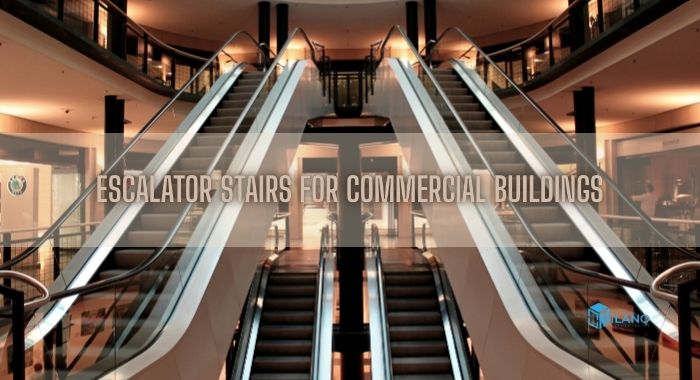
Walk into any modern shopping mall in Lahore, Karachi, or Islamabad and the first thing that catches your eye is not the brand signage. It is the smooth, continuous flow of people gliding between floors on escalator stairs. For commercial buildings in Pakistan, this is no longer a luxury. It is fast becoming a functional necessity.
But choosing the right escalator system involves more than just picking a product. You need to understand how these systems work, what features matter in a commercial setting, and why the wrong choice costs you far more in the long run than getting it right from the start.
This guide covers everything you need to know before investing in escalator stairs for your commercial property.
What Are Escalator Stairs and How Do They Work?
Escalator stairs are motorized moving staircases that carry people between floors of a building using a continuous loop of linked steps driven by an electric motor and chain system. Unlike an elevator that moves a limited number of people per trip, escalator stairs run non-stop, creating an uninterrupted flow of foot traffic at all times.
The mechanism consists of individually linked steps mounted on a track. The design keeps each step tread perfectly horizontal as it moves, so passengers can stand safely throughout the ride.
What many building owners miss is the revenue angle. In department stores and commercial spaces, escalators often serve as a center of attraction. The most profitable retail zones are typically positioned in line with or adjacent to the escalator, because the moving stairs naturally expose customers to each floor as they travel through the building. That is a passive sales tool built into your architecture.
Types of Escalator Stairs for Commercial Buildings
Not every building has the same space, traffic volume, or design requirements. Here is a breakdown of the main escalator stair types used in commercial settings across Pakistan:
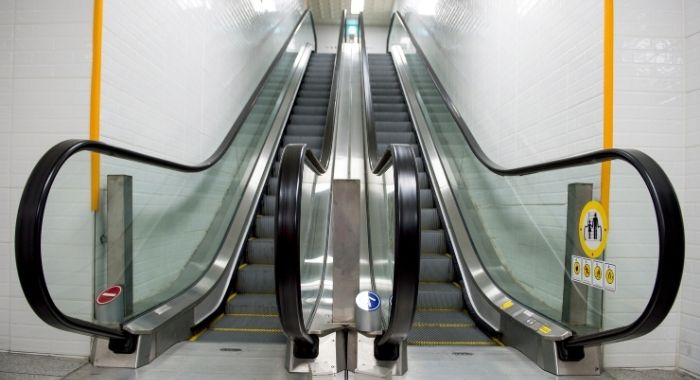
- Parallel Escalators: The most common layout in Pakistani malls and plazas. Two escalators run side by side, one going up and one going down. This setup maximizes traffic flow without confusion.
- Criss-Cross Escalators: Used in multi-floor commercial centers where floor space is tighter. The up and down escalators are staggered diagonally, reducing the floor footprint significantly.
- Spiral Escalators: A premium option seen in high-end retail flagships globally. These curve around a central axis and work as a visual centerpiece. They require custom engineering and a higher investment.
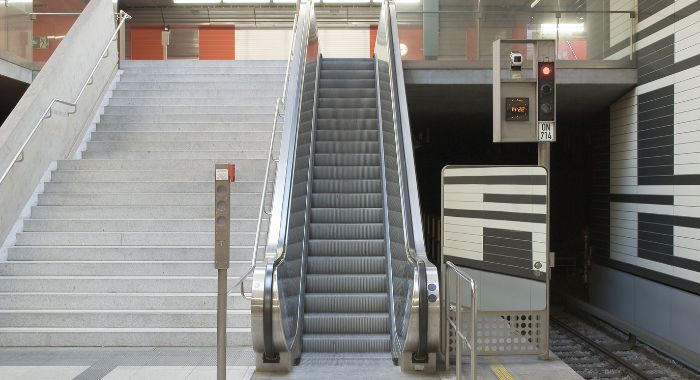
- Heavy-Duty Transit Escalators: Designed for airports, metro stations, and large convention centers where passenger volume is far higher than in standard retail. These heavy-duty models are built for durability and smooth people flow even in the most demanding high-traffic environments.
Key Features to Demand in a Commercial Escalator
Before signing any purchase order, your technical team should verify these core features:
Built-In Safety Systems
Safety is non-negotiable in a public-facing commercial environment. A quality escalator stair unit should include:
Comb plate protection that halts the escalator the moment any foreign object gets caught between the comb and the step surface. Handrail entry guards that stop the unit if anything is pulled into the handrail belt. Overspeed protection that automatically triggers a stop when the unit exceeds its rated speed. Emergency stop buttons accessible at both the top and bottom landings. Anti-reversal protection that prevents the escalator from running in the wrong direction. Phase loss protection is also critical, where if phase loss or wrong phase is detected, the unit stops automatically to prevent motor damage.
Energy Efficiency
This is where many buyers in Pakistan do not ask enough questions. A standard shopping mall escalator with a 7.5 horsepower motor, running 14 hours a day six days a week, consumes around 7,500 kilowatt-hours of electricity per year. A larger unit running continuously in a convention center or hotel can reach 31,000 kWh annually.
Energy-saving features that reduce this significantly include variable speed drives that slow the escalator when no passengers are detected, regenerative braking that recovers energy on heavily used down escalators, and LED lighting for skirt guards and step edges. Improvements in lighting alone can save between 1,600 and 2,000 kWh per year per unit, which adds up fast when electricity tariffs keep rising.
Step Width Options
Commercial escalator stairs typically come in three step widths: 600mm for lighter traffic corridors, 800mm for standard retail environments, and 1,000mm for high-volume spaces like airports and metro stations. For most Pakistani commercial buildings, 800mm is the standard baseline.
Commercial Escalator Stairs: Feature Comparison Table
Feature | Standard Commercial | Heavy-Duty Transit | Premium Retail |
Step Width | 800mm | 1,000mm | 800mm to 1,000mm |
Speed | 0.5 m/s | 0.65 m/s | 0.5 m/s |
Motor Type | Geared traction | Gearless traction | Gearless traction |
Energy Mode | Basic | Variable speed drive | Regenerative + VSD |
Annual Energy Use | 7,500 kWh approx | 31,000 to 60,000 kWh | 5,000 to 8,000 kWh with regeneration |
Typical Applications | Malls, plazas, offices | Airports, metro, stadiums | High-end retail, hotels |
Outdoor Rated Option | Sometimes | Yes | Yes |
Certification Standard | ISO 25745 | ISO 25745 | ISO 25745 + EN115 |
Energy data sourced from: U.S. Energy Star Escalators Program and Slate Energy Analysis
Top Benefits of Installing Escalator Stairs in Your Building
Continuous Passenger Flow Without Waiting
The single biggest operational advantage of escalator stairs over elevators is the absence of waiting time. Escalators have no waiting interval under normal conditions. They can move large numbers of people continuously, guide visitors toward specific floors or exits, and can even be weatherproofed for outdoor installation.
For a busy commercial building in Karachi or Lahore, this matters enormously during peak hours.
They Remain Useful Even When Power Fails
A non-functional escalator can still be used as a normal staircase, whereas many other transport methods become completely useless during a breakdown or power outage. In a country where power fluctuations remain a reality, this dual-function characteristic is a genuine practical advantage.
Better Retail Performance for Your Tenants
If you are a commercial building developer or mall operator, this point directly affects your rental income. When tenants on upper floors are more accessible, their foot traffic increases, their sales improve, and their ability to pay competitive rent strengthens. Escalators are not just a transport system. They are a commercial asset.
Accessibility for All Visitors
Well-designed escalator stairs accommodate elderly visitors, people carrying large bags or shopping trolleys, and parents with strollers far more comfortably than stairwells. Escalators are designed to accommodate a wide range of users, including individuals with mobility challenges, the elderly, and those carrying heavy items, making the continuous flow of movement ideal for large-scale commercial spaces.
What to Consider Before Installing Escalator Stairs in Pakistan
- Vertical Rise: The height between your floors determines the size and type of escalator needed. Standard commercial floor-to-floor heights in Pakistan range from 3.5 to 5 meters.
- Passenger Volume: Estimate peak hour traffic realistically. Under-specifying capacity leads to dangerous crowding. Over-specifying wastes energy and capital.
- Incline Angle: Standard commercial escalators operate at a 30-degree incline. Transit models designed for heavy use sometimes run at 35 degrees to reduce the overall footprint.
- Maintenance Access: Choose a supplier who offers local after-sales service. An escalator out of service is a liability, not just an inconvenience. Verify that spare parts are available locally and that service technicians are based in your city.
- Certification and Compliance: Insist on units that comply with EN 115 (European Safety Standard for Escalators) and ISO 25745 energy efficiency standards. These international standards are designed to support building owners, developers, maintenance providers, and inspecting authorities in ensuring efficient and effective escalator operation.
Common Mistakes Commercial Buyers Make
Choosing the lowest price without checking step quality, motor specifications, or the supplier’s after-sales network is the most expensive decision you will make. Many building owners in Pakistan discover this only after installation, when parts are unavailable or maintenance costs exceed the original savings.
Another mistake is ignoring energy mode options. Specifying a basic non-variable-speed unit when your building has low to medium traffic levels means you pay full energy costs even when the escalator runs empty for hours.
Finally, ignoring aesthetic integration is more costly than it seems. Escalator stairs are one of the most visible elements inside any commercial building. Glass balustrades, LED-lit steps, and polished stainless steel finishes add significant perceived value to your property and reinforce the quality signal your tenants and customers respond to.
Why Milano Technologies for Escalator Stairs in Pakistan
At Milano Technologies, our escalator systems are engineered specifically for commercial environments across Pakistan. We supply and install KOYO escalator solutions that meet international safety and energy standards, backed by dedicated technical teams in Lahore, Islamabad, and Karachi.
Whether you are developing a shopping mall in Gulberg, a mixed-use tower in DHA Islamabad, or a commercial complex in Karachi, our team assesses your building requirements and recommends the right escalator configuration for your traffic volume, floor height, and design objectives.
Our offices are located at:
Lahore: 55-N Gulberg-2
Islamabad: I-9/3 Industrial Area
Karachi: Mehran Town, Korangi
Contact Milano Technologies today for a site assessment and escalator installation quote.