Book Appointment Now

Elevator vs Escalator: Which Is the Best Choice for Your Building?
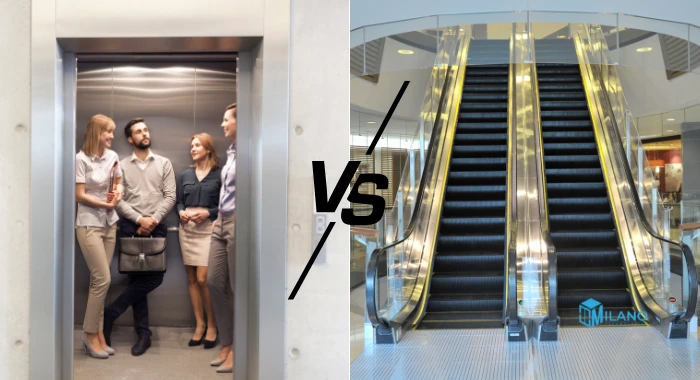
When planning vertical transportation for a building, the elevator vs escalator decision is one that directly impacts user experience, operational costs, safety compliance, and long-term return on investment. Both systems move people between floors, yet they serve different environments, populations, and purposes in ways that are rarely discussed in depth.
This guide breaks down what most comparisons miss, so you can make a well-informed decision before committing to either system.
What Most People Get Wrong About This Choice
The biggest misconception is treating this as a preference question. It is actually a functional engineering decision shaped by building type, daily traffic volume, user demographics, and local building codes.
In high-traffic commercial hubs like airports, shopping malls, and metro stations, both systems often coexist. But in mid-rise residential buildings, hospitals, and office towers, one consistently outperforms the other, depending on a specific set of factors that we will cover below.
Elevator vs Escalator: Side-by-Side Comparison
| Factor | Elevator | Escalator |
|---|---|---|
| Accessibility (ADA/disability compliance) | Full compliance, required by law in most cases | Partial; does not serve wheelchair users independently |
| Passenger capacity per hour | 150 to 300 (standard cab) | 2,000 to 6,000 (high-speed models) |
| Space required (footprint) | Compact vertical shaft, small floor area | Large horizontal footprint across multiple floors |
| Energy consumption | 5 to 15 kWh per day (regenerative models lower) | 5 to 20 kWh per day (varies with load sensors) |
| Installation cost (average) | $75,000 to $250,000+ | $30,000 to $100,000 per floor unit |
| Maintenance frequency | Every 3 to 6 months | Monthly to quarterly |
| Average lifespan | 20 to 30 years | 20 to 25 years |
| Usable when power fails | No (unless battery backup installed) | No |
| Goods and freight transport | Yes | No |
| User wait time | 30 seconds to 3 minutes | Immediate (continuous movement) |
Sources: ASME A17.1 Safety Code, U.S. Access Board ADA Standards
Elevator Advantages That Go Beyond the Obvious
Elevators are the default solution in many buildings, but the reasons go deeper than convenience.
- Universal access is non-negotiable in most jurisdictions. Under the Americans with Disabilities Act (ADA) and equivalent legislation globally, multi-story buildings serving the public must provide accessible vertical transport. An escalator alone does not meet this requirement. An elevator does.
- Elevators handle mixed cargo loads. Hospital gurneys, restaurant supply deliveries, office furniture relocations, and wheelchair mobility devices all require an enclosed cab with a flat floor. Escalators cannot serve any of these use cases.
- Machine room-less (MRL) technology has significantly reduced the shaft space and construction costs that once made elevators impractical for smaller buildings. Modern hydraulic and traction MRL elevators can be installed in buildings as low as two stories with minimal structural modification.
- Smart dispatch systems in modern elevators use destination control technology, where users input their floor before entering the cab. This reduces average wait times by up to 30% compared to conventional call button systems, according to data from Schindler and KONE.
Where Escalators Outperform Elevators Decisively
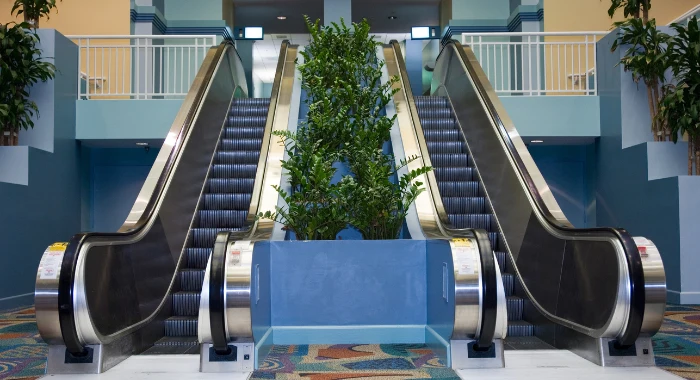
Escalators solve a problem that elevators simply cannot: continuous, high-volume flow of pedestrians across one or two floors with zero wait time.
A single escalator unit can move between 2,000 and 6,000 people per hour depending on speed and width. A standard elevator cab, even with a short 30-second wait cycle, cannot approach this throughput. This is why every international airport, major transit hub, and large-format retail center relies primarily on escalators for their primary vertical circulation.
- Energy efficiency with load sensors is another underreported escalator advantage. Modern escalators from manufacturers like ThyssenKrupp and Mitsubishi Electric include automatic speed reduction and standby modes that activate when no passengers are detected, cutting energy use by up to 40% during off-peak hours.
- Lower upfront installation cost per unit is also relevant for developers working within tight construction budgets. A single escalator flight typically costs less than a full elevator installation, though the total cost comparison shifts once you factor in the mandatory accessibility elevator that must accompany it.
The Accessibility Equation: A Factor You Cannot Ignore
One of the most important and frequently overlooked points in the elevator vs escalator debate is this: an escalator can never replace an elevator from a legal or ethical standpoint.
The International Building Code (IBC), ADA guidelines in the United States, and equivalent standards in the UK, EU, and across Asia all require that any building with public access and multiple floors must provide at minimum one accessible vertical transportation route. Escalators do not qualify.
This means that in virtually every public or commercial building, installing an escalator does not eliminate the need for an elevator. The two systems are complementary, not interchangeable, and the actual decision is often whether to install only an elevator, or both.
Maintenance, Downtime, and Long-Term Operating Costs
Neither system is maintenance-free, but the nature of their upkeep differs significantly.
Elevators require certified technician inspections every three to six months under most state and national codes. Major component replacements such as cables, controllers, and door systems are infrequent but costly, typically occurring every 10 to 15 years.
Escalators have more moving parts in continuous contact with passengers. Steps, handrails, combs, and drive chains require monthly lubrication checks and quarterly inspections in high-traffic environments. Step replacement and chain maintenance are recurring costs that escalate with passenger volume.
From a downtime perspective, a broken elevator in a building that depends solely on it is a serious liability, particularly for elderly or disabled occupants. A broken escalator in a multi-unit installation is less critical, as remaining units absorb the load.

Which Buildings Benefit Most From Each System?
Elevators are the clear choice for:
Residential towers and apartment complexes, hospitals and medical facilities, office buildings over three stories, hotels, government buildings, and any structure serving people with mobility limitations.
Escalators are the optimal primary system for:
Airports, shopping centers, convention centers, metro and railway stations, and large retail stores spanning two to three floors where high throughput and continuous movement are priorities.
Both systems working together are standard in:
Department stores, mixed-use developments, major transit hubs, and any facility exceeding 50,000 square feet with multiple public-facing floors.
Make the Right Investment for Your Building
Choosing between an elevator and an escalator is not a matter of preference. It is a decision grounded in your building’s function, the people who use it daily, your regulatory obligations, and your long-term operating budget.
At Milano Technology, we specialize in helping building owners, architects, and facility managers select, install, and maintain the right vertical transportation systems. Whether your project calls for a cutting-edge MRL elevator, a high-capacity commercial escalator, or an integrated combination of both, our engineering team brings decades of hands-on experience to every installation.
Contact Milano Technology today to get a tailored consultation and a transparent cost estimate for your building’s vertical transportation needs. The right system, installed right, pays for itself in safety, efficiency, and tenant satisfaction for decades to come.