Book Appointment Now

How Moving Walkways Work in Airports and Shopping Malls
You have probably stepped onto one without thinking twice. That slow, gliding belt that carries you through a long airport terminal or across a busy shopping mall floor is called a moving walkway. It saves your legs, manages foot traffic, and makes large spaces feel smaller. But how exactly does it work, and why is this technology becoming increasingly important for modern infrastructure in countries like Pakistan?
This guide breaks down everything you need to know, from the engineering behind moving walkways to where they are used and what the future holds for this technology.
What Is a Moving Walkway and Where Did It Come From?
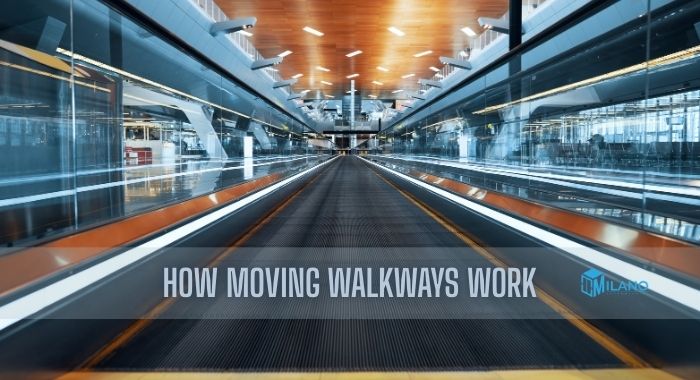
A moving walkway, also called a travelator, autowalk, or moving sidewalk, is a slow-moving conveyor system that transports people horizontally or on a slight incline across short to medium distances. Unlike escalators that move you vertically between floors, moving walkways are built for ground-level or gently inclined travel, covering distances that would otherwise require a tiring walk.
The concept is older than most people expect. The very first moving walkway debuted at the 1893 World’s Columbian Exposition in Chicago, designed by architect Joseph Lyman Silsbee. It operated in a loop along a lakefront pier and even had a seated section for passengers who did not want to stand. Six years later, Paris hosted another version at the 1900 Exposition Universelle. These were novelties at the time, but the idea planted a seed that eventually grew into critical airport and mall infrastructure across the world. Wikipedia
The Core Mechanics: How a Moving Walkway Actually Works
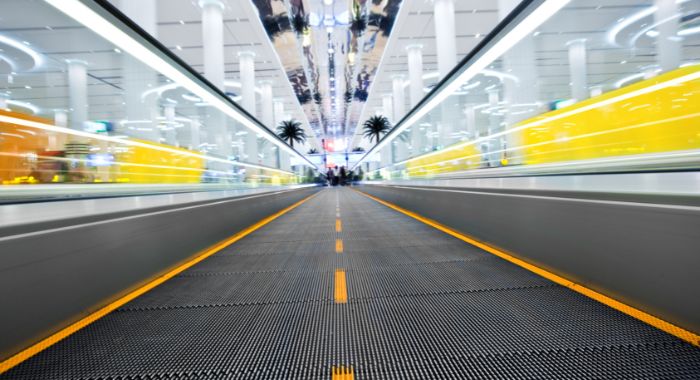
At its core, a moving walkway functions much like a flat escalator. The system is driven by an electric motor, usually an AC induction motor, which powers a continuous loop of either metal pallets or a rubber belt. Here is what makes up the key components:
- The Drive Motor: An electric motor, typically variable frequency driven in modern installations, powers the entire system. Variable frequency drives (VFDs) allow the speed to be adjusted and even reduced when the walkway is idle, saving significant energy costs.
- The Treadway Surface: This is what you stand on. It is either a series of interlocking metal pallets (die-cast aluminium, typically 800 to 1,200 mm wide) or a rubber belt running over metal rollers. Pallet-type systems are stronger and more common in airports. Belt-type systems are lighter and used in lower-traffic environments.
- Handrails: These are rubber loops that run alongside the treadway surface, moving at the same speed, giving passengers something stable to hold. The handrail loop is driven by the same motor system to stay perfectly in sync with the floor surface.
- The Comb Plate: At each entry and exit point, there are grooved metal plates that mesh with the grooves on the treadway surface. This is what safely guides your feet on and off the walkway without catching shoes or bags.
- The Truss: The entire mechanical assembly sits inside a metal truss structure installed into the floor. In most standard installations, this requires a pit of approximately one metre in depth running the full length of the walkway.
The walkway runs on a continuous loop. The treadway goes forward on top, passengers ride it, then the surface loops back underneath and returns to the start. The motor keeps this loop running smoothly, and sensors at entry and exit points can detect passenger presence to adjust speeds in smart systems.
Two Types of Moving Walkways You Should Know
Not all moving walkways are built the same way. There are two main categories used around the world:
1- Pallet-Type Moving Walkways:
These use interlocking flat metal plates, similar in construction to escalator steps, but laid flat. They are extremely durable, suitable for 24/7 operation, and are the standard choice for international airports. The pallets are typically die-cast aluminium, can be up to 1,200 mm wide, and operate at speeds between 0.5 and 0.75 metres per second. Maximum incline for pallet-type systems is 12 degrees under international safety standards.
2- Belt-Type Moving Walkways:
These use a continuous rubber or mesh-metal belt running over rollers. They are lighter in construction, lower in installation cost, and more common in shopping malls and smaller transit stations. The surface provides good grip and is quieter in operation compared to metal pallet systems.
Moving Walkways in Airports: A Necessity, Not a Luxury
Airports are the single largest users of moving walkways globally. As terminals grow, the distance between check-in counters, gates, and baggage claim areas can stretch across hundreds of metres. For a passenger with heavy luggage rushing to catch a connecting flight, that distance becomes a serious problem.
Moving walkways installed in airports typically operate at about 0.5 metres per second (roughly 1.8 km/h), which is considerably slower than an average walking pace of about 4.8 km/h. This might seem counterproductive, but research shows that passengers instinctively slow their walking pace when they step onto a walkway. The real value is not dramatically cutting travel time, it is reducing physical effort, managing congestion, and improving accessibility for elderly travellers or those with reduced mobility.
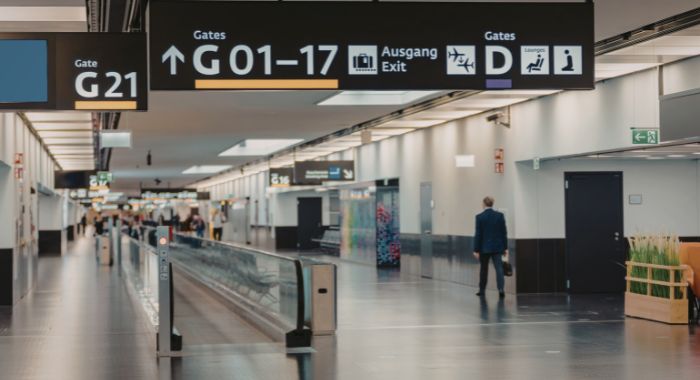
Airport moving walkways are almost always installed in pairs, one in each direction of travel, placed in long corridors or inter-terminal connectors. They are typically 3 to 4 feet wide to accommodate a person with luggage standing alongside someone walking.
Moving Walkways in Shopping Malls: Managing Crowds Across Floors
In shopping malls, moving walkways serve a different but equally important purpose. Large multi-level malls use inclined travelators (set at angles up to 12 degrees) to move shoppers between floors while they push trolleys or carry bags. This is something conventional escalators cannot handle, because escalator steps are not flat and shopping trolleys cannot safely be placed on them.
Inclined moving walkways in malls are specifically designed to allow shopping cart movement between levels, which is why large supermarkets inside malls often use them as the primary means of floor-to-floor movement. This boosts both accessibility and the overall shopping experience, encouraging customers to explore multiple floors without the fatigue of carrying items up stairs or waiting for elevators.
Key Specifications: What the Numbers Tell You
Feature | Standard Specification |
Typical Operating Speed | 0.5 m/s (standard), 0.65 m/s (fast), max 0.75 m/s |
Maximum Incline Angle | 12 degrees (international safety standard) |
Maximum Conveyor Length | Up to 500 metres per unit |
Treadway Width | 800 mm to 1,200 mm |
Passenger Capacity | Up to 7,500 persons per hour (modern systems) |
Power Source | AC Induction Motor with optional VFD |
Standard Installation Depth | Approximately 1 metre floor pit |
Energy Feature | Motion-sensor standby mode (smart systems) |
Smart and Energy-Efficient Moving Walkways: The Modern Standard
One underreported fact about moving walkways is how much energy they consume when running constantly with no passengers. This is why modern installations now rely heavily on motion-sensor technology and variable frequency drives. When no passenger is detected at the entry point, the walkway slows to a near-stop or enters a low-speed standby mode. The moment someone approaches, it ramps back to full operating speed within seconds.
According to the Airport Cooperative Research Program (ACRP), new technologies including speed control through variable frequency drives, regenerative braking systems, and power factor control can result in measurable energy savings and lower operational costs for airports. These upgrades are especially valuable in installations that run 24 hours a day. ACRP Report 117
Why Moving Walkways Matter for Pakistan’s Growing Infrastructure
Pakistan’s infrastructure is growing rapidly. New terminals at Islamabad International Airport, ongoing expansion of commercial malls in Karachi, Lahore, and Islamabad, and large-scale mixed-use developments are all creating genuine demand for horizontal passenger transport systems.
Currently, the moving walkway market globally is valued at approximately USD 3.5 billion and is projected to grow at a CAGR of 4.8% through 2030, driven largely by urbanization and airport expansion across South and Southeast Asia. Pakistan sits directly in that growth corridor.
For developers, architects, and facility managers planning large public spaces in Pakistan today, specifying the right moving walkway system from a qualified supplier is not a decision to take lightly. Factors including expected daily passenger load, the length of the corridor, indoor versus outdoor installation, and maintenance infrastructure all determine whether a pallet-type or belt-type system is the correct choice.
Milano Technologies supplies and installs moving walkways suited for airports, commercial malls, hospitals, and public facilities across Pakistan. Contact our offices in Lahore, Islamabad, or Karachi to discuss specifications for your project.
Frequently Asked Questions About Moving Walkways
What is the difference between a moving walkway and an escalator?
An escalator moves people vertically between floors using stepped surfaces. A moving walkway transports people horizontally or on a gentle incline, keeping the surface flat throughout, making it suitable for luggage, trolleys, and passengers who need level ground.
How fast do moving walkways go?
Standard moving walkways operate at 0.5 metres per second. High-speed models can reach 0.75 metres per second. Some experimental accelerating walkway systems have reached up to 15 km/h in demonstration prototypes, though these are not yet in widespread commercial use.
Can shopping trolleys be used on moving walkways?
Yes, inclined travelators in shopping malls are specifically designed to accommodate shopping trolleys. The flat, grooved surface prevents trolleys from rolling backward during incline travel.
Are moving walkways safe for elderly or disabled users?
Yes. Moving walkways include handrails that move at the same speed as the surface, making them safer and more comfortable for elderly travellers or those with limited mobility compared to stairs or ramps.
How long does a moving walkway last?
With proper maintenance, a good quality moving walkway has an operational lifespan of 15 to 25 years. Regular inspection of the drive motor, handrail tension, comb plates, and surface pallets is essential for safe long-term operation.